Mayor’s Tariff Task Force Deepens Efforts to Strengthen Brampton’s Economic Resilience Amid Global Trade Pressures

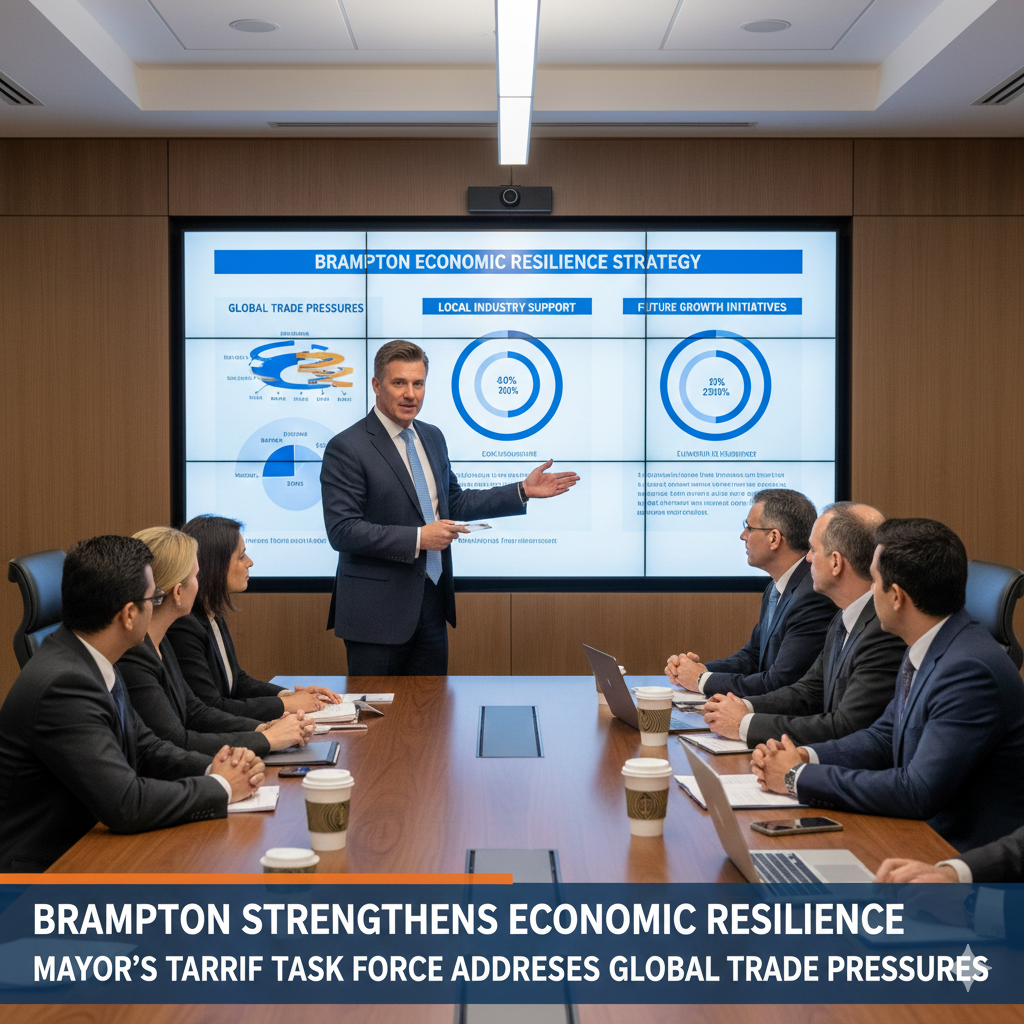
As global trade conditions continue to shift and uncertainty around tariffs persists, the City of Brampton is reinforcing its commitment to protecting and strengthening the local economy. Building on earlier momentum, the Mayor’s Tariff Task Force convened for its second high-level roundtable meeting in late December, bringing together leaders from government, industry, and economic development to chart a path forward for businesses navigating an increasingly complex international trade environment.

Hosted by Invest Brampton, the city’s Economic Development Office, the meeting underscored Brampton’s proactive approach to safeguarding jobs, supporting exporters, and ensuring the city remains competitive on the global stage.

Building on the Foundation Laid Earlier This Year

The second roundtable follows the formal launch of the Mayor’s Tariff Task Force in April, an initiative designed to address the real and potential impacts of tariffs and trade disruptions on Brampton’s diverse economy. From the outset, the task force has focused on collaboration, data-driven policy discussions, and practical solutions for businesses facing rising costs, supply chain disruptions, and shifting market access.

City officials emphasized that the December meeting was not a standalone event, but part of an ongoing strategy to strengthen economic resilience.

By reconvening stakeholders before the end of the year, Brampton aimed to assess progress made since the inaugural meeting, identify emerging risks, and refine support mechanisms for companies operating across borders.

A Cross-Sector Roundtable Reflecting Brampton’s Economic Diversity

Representation From Key Economic Pillars

The roundtable brought together representatives from industries that form the backbone of Brampton’s economy. These sectors play a critical role in employment, innovation, and exports, making them particularly sensitive to changes in global trade policy.

Key sectors represented included:

  • Advanced manufacturing

  • Innovation and technology

  • Food and beverage processing

  • Logistics and supply chain management

This cross-sector participation allowed for a comprehensive discussion of how tariffs and trade barriers affect different parts of the local economy, from raw material sourcing to finished goods distribution.

Industry Leaders Share Frontline Perspectives

Participants included senior leaders and representatives from a wide range of prominent organizations, reflecting both multinational and homegrown enterprises. Among those contributing to the discussion were representatives from MDA Space, Canon Canada, ALMAG Aluminum, Daybar Industries Limited, Peel Plastic Products Ltd., Sofina Foods Canada, Zochem LLC, Adamas International, and Prologis.

Labour and workforce perspectives were also present, with Unifor participating in the discussion, alongside business advocacy and support organizations such as the Brampton Board of Trade and BHive.

Financial and trade support institutions, including TD Commercial Banking, Export Development Canada, and the Trade Commissioner Service, added further depth by highlighting available tools to help businesses manage risk, access new markets, and finance growth.

Together, these voices provided a real-world snapshot of how global trade shifts are being felt on the ground in Brampton.

Federal and Municipal Leadership Align on Trade Strategy

Mayor Patrick Brown Emphasizes Proactive Action

Mayor Patrick Brown played a central role in the meeting, reiterating the city’s determination to stay ahead of global economic challenges rather than reacting after damage has been done.

He emphasized that tariffs and trade disputes are not abstract policy issues but have direct consequences for local employers, workers, and families. By convening the task force, the city aims to ensure Brampton businesses have access to timely information, advocacy, and coordinated support.

The Mayor highlighted that collaboration across levels of government is essential to achieving meaningful results, particularly when dealing with international trade dynamics beyond municipal control.

Federal Presence Reinforces National Commitment

The roundtable was joined by the Honourable Maninder Sidhu, P.C., M.P., Canada’s Minister of International Trade, underscoring the importance of federal-municipal cooperation. His participation provided businesses with direct access to federal insights on trade policy, international negotiations, and export support programs.

Minister Sidhu discussed the federal government’s role in promoting Canadian competitiveness abroad, diversifying trade relationships, and supporting companies facing tariff-related pressures. His presence also allowed local industry leaders to raise concerns and questions directly with a senior decision-maker.

Regional and City Leaders at the Table

Regional Councillor Gurpartap Singh Toor, serving as Chair of Economic Development, and Regional Councillor Rowena Santos, Vice-Chair, also took part in the discussions. Senior members of Brampton’s Economic Development team contributed data, analysis, and updates on city-led initiatives aimed at supporting investment, innovation, and workforce development.

This mix of political leadership and technical expertise helped ensure discussions were both strategic and grounded in operational realities.

Addressing the Real-World Impacts of Tariffs

Supply Chains, Costs, and Competitiveness

One of the central themes of the roundtable was the impact of tariffs on supply chains. Manufacturers and processors shared how increased input costs, delays, and uncertainty can ripple through operations, affecting pricing, contracts, and long-term planning.

Logistics companies highlighted challenges related to border efficiency, transportation costs, and compliance requirements, all of which influence Brampton’s role as a major distribution hub.

Participants stressed that even when tariffs do not apply directly to finished products, indirect effects—such as higher material costs or disrupted supplier relationships—can significantly affect competitiveness.

Supporting Small and Medium-Sized Enterprises

While large multinational firms may have more resources to adapt to trade disruptions, small and medium-sized enterprises often face greater vulnerability. Task force discussions emphasized the need for targeted support for these businesses, including access to market intelligence, financing tools, and export readiness programs.

Representatives from Export Development Canada and the Trade Commissioner Service outlined available supports designed to help companies mitigate risk, identify alternative markets, and navigate regulatory requirements abroad.

Strengthening Brampton’s Economic Resilience

Innovation and Diversification as Long-Term Solutions

Beyond immediate tariff concerns, the roundtable focused on long-term resilience strategies. Diversifying export markets, investing in innovation, and strengthening local supply chains were identified as key priorities.

Technology and innovation leaders highlighted the importance of research and development, automation, and digital transformation in helping companies remain competitive regardless of trade fluctuations.

City officials noted that Brampton’s growing innovation ecosystem, combined with its strategic location and skilled workforce, positions it well to adapt—provided businesses have the right supports in place.

Collaboration as a Competitive Advantage

A recurring message throughout the meeting was that collaboration itself is a critical economic asset. By bringing together government, industry, labour, and financial institutions, the Mayor’s Tariff Task Force creates a platform for shared problem-solving and coordinated advocacy.

Participants agreed that open dialogue helps identify issues earlier and ensures policy responses are informed by real business experiences rather than assumptions.

Next Steps and Ongoing Engagement

From Discussion to Action

City officials confirmed that insights gathered during the second roundtable will inform ongoing work by Invest Brampton and the Mayor’s Tariff Task Force. This includes refining advocacy priorities, enhancing business support programs, and strengthening communication with provincial and federal partners.

Follow-up engagement with participating organizations is expected, ensuring that momentum from the meeting translates into tangible outcomes.

Commitment to Continued Dialogue

The City of Brampton signaled that the task force will continue to meet as trade conditions evolve. Regular engagement allows the city to remain responsive to new challenges while tracking progress on previously identified issues.

By maintaining this ongoing forum, Brampton aims to ensure its economic strategy remains agile and inclusive.

Conclusion: Positioning Brampton for a Changing Global Economy

The second meeting of the Mayor’s Tariff Task Force marked another important step in Brampton’s efforts to protect and strengthen its economy amid global trade uncertainty. By convening leaders from across sectors and levels of government, the city reaffirmed its commitment to collaboration, resilience, and proactive economic leadership.
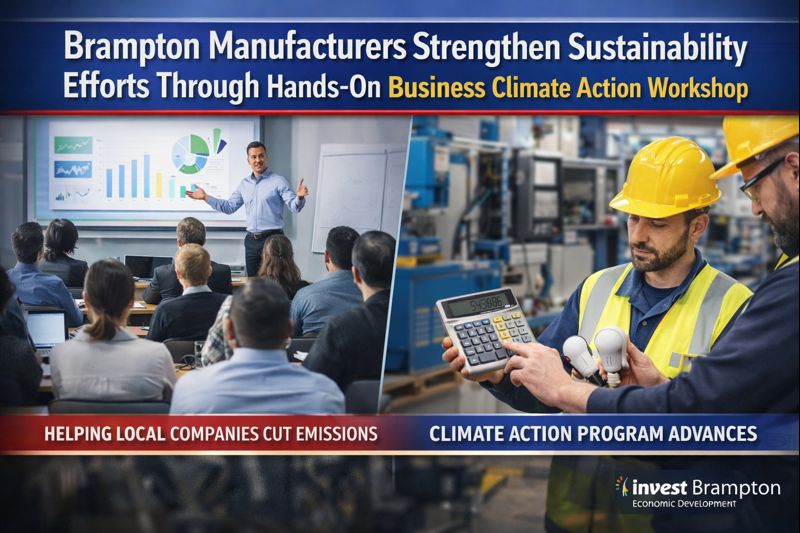
Brampton Manufacturers Strengthen Sustainability Efforts Through Hands-On Business Climate Action Workshop

City-Led Initiative Helps Local Businesses Cut Emissions, Reduce Costs, and Build a Competitive Future

Brampton manufacturers are taking significant steps toward a more sustainable and resilient future following a collaborative business workshop designed to turn climate goals into measurable action. Hosted by the City of Brampton’s Invest Brampton – Economic Development Office in partnership with Toronto and Region Conservation Authority’s (TRCA) Partners in Project Green, the Business Climate Action Workshop brought together manufacturers from across Brampton and the Region of Peel to explore practical, cost-effective strategies for reducing emissions while improving operational performance.

Held as part of the broader Brampton Climate Action Program, the interactive session focused on equipping businesses with the tools, insights, and expert support needed to improve energy efficiency, lower operating costs, and strengthen long-term competitiveness. Organizers say the workshop reflects Brampton’s growing emphasis on supporting industry-led sustainability initiatives that deliver real economic and environmental value.

Supporting Manufacturers Through Practical Climate Solutions

The workshop was specifically designed for manufacturers seeking actionable guidance rather than high-level theory. Participants engaged in hands-on exercises, expert-led discussions, and peer learning opportunities tailored to the unique challenges faced by industrial and manufacturing operations.

A Collaborative Approach to Climate Action

By partnering with TRCA’s Partners in Project Green, the City of Brampton ensured participants had access to proven frameworks and technical expertise rooted in regional best practices. The collaboration allowed businesses to examine their own operations through a sustainability lens, identifying opportunities to reduce greenhouse-gas emissions without compromising productivity or profitability.

Representatives from Invest Brampton emphasized that supporting local manufacturers is a key pillar of the city’s economic development strategy.

“Manufacturing is a critical driver of Brampton’s economy,” city officials noted. “Helping businesses reduce costs, improve efficiency, and adapt to a low-carbon future strengthens not only individual companies, but the broader economic resilience of our city.”

Inside the Business Climate Action Workshop

The workshop brought together manufacturers from Brampton and across the Region of Peel, creating a forum for shared learning and cross-industry collaboration.

Practical Tools and Expert Guidance

Participants received practical tools to assess energy use, identify emissions hotspots, and evaluate potential improvements within their facilities. Industry experts provided guidance on energy-efficient technologies, process optimization, and operational changes that can deliver both environmental and financial benefits.

In addition to technical insights, businesses were introduced to available funding programs, incentives, and rebates designed to offset the cost of implementing sustainability initiatives. These funding pathways are often underutilized due to lack of awareness or complexity, and the workshop aimed to bridge that gap.

Learning From Local Leaders

A key feature of the session was the opportunity for participants to hear directly from companies already leading environmental change through the Brampton Climate Action Program. These real-world case studies highlighted how local manufacturers have successfully implemented climate solutions, reduced emissions, and realized measurable cost savings.

Organizers say peer-to-peer learning helped demystify sustainability efforts and demonstrated that climate action is achievable for businesses of all sizes.

Delivering Real, Measurable Impact

The outcomes of the workshop and its associated pilot program underscore the tangible value of business-focused climate action.

Identifying Emissions Reduction Opportunities

Through assessments and collaborative analysis, the initiative identified 54 distinct opportunities for participating businesses to reduce greenhouse-gas emissions. These opportunities ranged from equipment upgrades and energy-efficiency improvements to operational changes that reduce waste and energy consumption.

Collectively, the identified measures represent an estimated reduction of 86 tonnes of carbon dioxide emissions. For participating manufacturers, these reductions translate into both environmental benefits and long-term cost savings.

Unlocking Funding and Incentives

One of the most significant outcomes of the program was helping businesses access financial support to implement identified improvements. The initiative unlocked more than a quarter-million dollars in incentives and funding, reducing the upfront costs associated with sustainability upgrades.

For many manufacturers, access to funding is a critical factor in moving from planning to implementation. By connecting businesses with available programs, the workshop helped remove a common barrier to action.

“These are not abstract numbers,” organizers emphasized. “They represent real savings, real emissions reductions, and real progress for Brampton’s manufacturing sector.”

Building Operational Resilience and Competitive Advantage

Beyond immediate cost and emissions reductions, the workshop highlighted the broader business benefits of sustainability.

Strengthening Long-Term Resilience

As energy prices fluctuate and environmental regulations continue to evolve, manufacturers that invest in efficiency and emissions reduction are better positioned to adapt. Workshop facilitators emphasized that sustainability is increasingly linked to risk management, supply chain stability, and long-term operational resilience.

Participants explored how climate-smart investments can protect businesses from future cost increases while improving reliability and performance.

Enhancing Brand Value and Market Position

Sustainability is also becoming a key differentiator in the marketplace. Customers, investors, and supply-chain partners are increasingly prioritizing environmental responsibility when making decisions.

By participating in the Business Climate Action Program, manufacturers are not only improving internal operations but also strengthening their brand reputation as responsible, forward-thinking businesses.

“Being future-ready is no longer optional,” workshop leaders noted. “Sustainability is a competitive advantage.”

Celebrating Leadership in Sustainability

The workshop also served as an opportunity to recognize companies demonstrating leadership and commitment to climate action.

Leadership in Sustainability Certificate

As part of the Business Climate Action Program, participating businesses were eligible for the Leadership in Sustainability Certificate, which acknowledges organizations that have taken meaningful steps toward reducing their environmental footprint.

Congratulations were extended to Designed Precision Castings Inc. (DPCast), which was recognized for its participation and leadership in advancing sustainability initiatives. The certification highlights the company’s commitment to continuous improvement and responsible manufacturing practices.

City officials say recognizing local leaders helps inspire other businesses to take similar steps and reinforces the value of collective action.

A Growing Momentum for Climate Action in Brampton

The success of the Business Climate Action Workshop reflects a broader shift within Brampton’s business community toward proactive sustainability planning.

Aligning Economic Growth With Environmental Responsibility

Invest Brampton’s involvement underscores the city’s commitment to aligning economic development with climate objectives. By supporting manufacturers through education, partnerships, and funding access, the city aims to ensure economic growth remains both inclusive and environmentally responsible.

The partnership with TRCA’s Partners in Project Green also highlights the importance of regional collaboration in addressing climate challenges that extend beyond municipal boundaries.

Expanding the Program’s Reach

Following the strong results of the pilot initiative, organizers are exploring opportunities to expand similar workshops and support programs to reach more businesses across Brampton and the Region of Peel.

Future sessions may focus on sector-specific challenges, advanced energy solutions, or deeper technical assessments, building on the foundation established by the initial workshop.

Conclusion: Turning Climate Goals Into Business Success

The Business Climate Action Workshop demonstrated that sustainability and economic performance can go hand in hand. By providing manufacturers with practical tools, expert guidance, and access to funding, the City of Brampton and its partners have helped local businesses turn climate ambitions into concrete results.

With dozens of emissions-reduction opportunities identified, significant funding unlocked, and local leaders recognized for their efforts, the initiative has delivered meaningful impact for Brampton’s manufacturing sector.

As more businesses embrace climate-smart practices, Brampton continues to position itself as a city where innovation, sustainability, and economic growth move forward together.

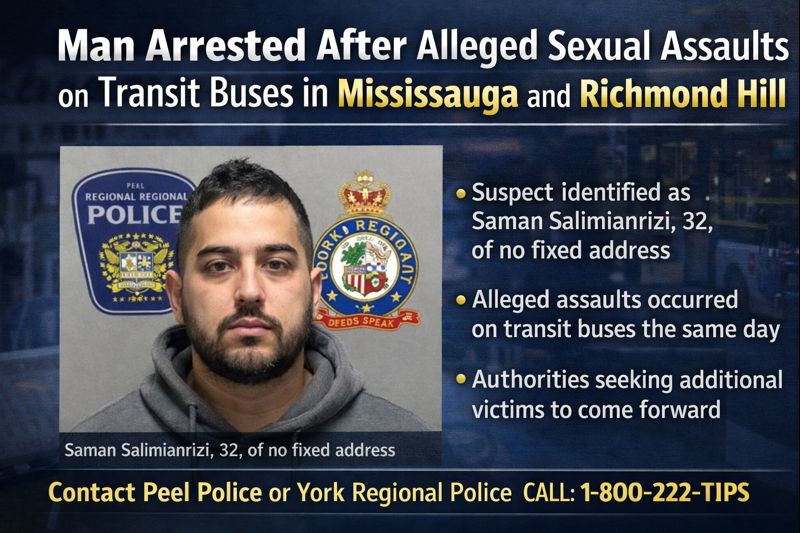
Man Arrested After Alleged Sexual Assaults on Transit Buses in Mississauga and Richmond Hill

A 32-year-old man has been arrested and charged following alleged sexual assaults on public transit buses in Mississauga and Richmond Hill, prompting police to warn that there may be additional victims who have yet to come forward. Investigators from both Peel Regional Police and York Regional Police say the incidents occurred on the same day and share similar circumstances, raising concerns about passenger safety on public transportation systems across the Greater Toronto Area (GTA).

Authorities have released the suspect’s image and details as part of an ongoing investigation, urging anyone with information or who may have been affected to contact police.

Alleged Sexual Assault on Mississauga Transit Bus

Incident Reported on November 18

According to Peel Regional Police, the first reported incident took place on November 18 aboard a transit bus in Mississauga. Investigators allege that the suspect boarded the bus and deliberately sat next to a woman he did not know.

While the bus was in motion, police say the man allegedly sexually assaulted the female passenger. The victim, whose identity has not been disclosed to protect her privacy, reported the incident to authorities shortly after it occurred.

Police allege that the suspect fled the bus immediately following the assault. However, Peel officers were able to locate and arrest him a short distance away from the scene.

Charges Laid by Peel Regional Police

Following his arrest, the suspect was identified as Saman Salimianrizi, 32, who is described by police as having no fixed address. Peel Regional Police charged Salimianrizi with one count of sexual assault related to the Mississauga incident.

In addition to the sexual assault charge, police also laid two counts of breaching probation. Authorities have not publicly detailed the conditions of the probation order but confirmed that Salimianrizi was bound by court-ordered restrictions at the time of the alleged offence.

He was held in custody pending a bail hearing and, according to police, remains detained.

Similar Allegations in Richmond Hill Under Investigation

Second Incident Occurred the Same Day

York Regional Police have also charged Salimianrizi in connection with a similar alleged sexual assault that occurred earlier the same day, November 18. That incident reportedly took place between 6 and 7 p.m. on a northbound transit bus traveling from Finch Station toward Richmond Hill.

Police allege that the circumstances surrounding the York Region incident closely resemble those reported in Mississauga. Investigators believe the suspect targeted a female passenger while onboard the bus, though further details about that incident have not been publicly released.

York Regional Police Lay Additional Charges

York Regional Police arrested Salimianrizi on December 18 after continuing their investigation into the Richmond Hill case. He was charged with one count of sexual assault in connection with that incident, along with two additional counts of breaching probation.

York police initially stated that they believed Salimianrizi traveled through multiple municipalities on the day of the alleged assaults, including Brampton, and may have targeted additional victims along the way.

Police Believe There May Be More Victims

Investigators Urge Public to Come Forward

Both Peel and York regional police services say they are concerned there may be other victims who have not yet reported incidents. Investigators believe the suspect may have used public transit as a means to access potential victims across different regions.

As part of their efforts to identify additional victims, police have released an image of Salimianrizi to the public. Authorities are urging anyone who may have had a similar experience or who recognizes the suspect to contact police.

“Investigators from both police forces believe there may be additional victims,” police stated in a joint appeal for information.

Victims and witnesses are encouraged to come forward, even if they are uncertain whether their experience is connected to the current investigation.

Public Transit Safety Under Scrutiny

Concerns for Passenger Security

The allegations have raised renewed concerns about safety on public transportation, particularly during busy commuting hours. Transit systems across the GTA carry thousands of passengers daily, and incidents of alleged sexual assault can have a lasting impact on riders’ sense of security.

Advocates for transit safety emphasize the importance of reporting inappropriate behavior immediately, using onboard emergency features where available, and alerting transit staff or police as soon as possible.

Police continue to stress that sexual assault can occur in any setting and that victims should not hesitate to seek help or support.

Support Services for Victims

Authorities remind victims of sexual assault that confidential support services are available. Local sexual assault crisis centers and victim support organizations offer counseling, medical assistance, and guidance through the reporting process.

Police also note that victims are not required to pursue criminal charges in order to access support resources.

Legal Process Moving Forward

Bail Hearings and Court Proceedings

Salimianrizi remains in custody as he awaits further court proceedings. Bail hearings and future court dates will determine whether he remains detained while the cases move through the justice system.

Under Canadian law, individuals charged with a criminal offence are presumed innocent unless and until proven guilty in a court of law. Police emphasize that the charges are allegations and will be tested through the judicial process.

Given the involvement of multiple police jurisdictions, coordination between Peel and York regional investigators is expected to continue as the cases progress.

Ongoing Investigation Across Multiple Regions

Police Collaboration Between Peel and York

The investigation highlights the importance of cooperation between police services when alleged offences cross municipal boundaries. Detectives from both regions are sharing information and evidence to ensure a thorough and coordinated approach.

Police have not ruled out the possibility of additional charges if more victims come forward or if further evidence is uncovered.

Transit authorities may also review surveillance footage and ridership data to assist investigators in reconstructing the suspect’s movements on the day of the alleged incidents.

Conclusion: Call for Vigilance and Community Support

The arrest of Saman Salimianrizi following alleged sexual assaults on transit buses in Mississauga and Richmond Hill has sparked concern among transit users and prompted a broader discussion about public safety. With charges laid in two separate jurisdictions and investigators warning of potential additional victims, police are urging the public to remain vigilant and report suspicious or inappropriate behavior.

As the legal process unfolds, authorities continue to emphasize the importance of community cooperation, victim support, and awareness in preventing and responding to sexual offences on public transportation. Anyone with information related to the investigation is encouraged to contact Peel Regional Police or York Regional Police as the search for further answers continues.

Season-Ending Suspension Handed to Brampton Steelheads Defenceman After Violent Stick Incident

A single moment. A split-second decision. And a season—along with a reputation—now hangs in the balance.

The Ontario Hockey League has delivered one of its most severe disciplinary rulings in recent memory, suspending a Brampton Steelheads player for the remainder of the season following a dangerous on-ice incident that crossed well beyond the accepted boundaries of the sport.

The ruling sends a clear message. Skill is celebrated. Toughness is respected. Violence, especially of this nature, is not tolerated.

Incident Triggers Swift League Response

The suspension stems from a Nov. 14 matchup between the Brampton Steelheads and the Oshawa Generals, played at Oshawa’s CAA Centre.

During the third period of the game, Brampton defenceman Luke Dragusica struck Oshawa forward Brady Blaseg in the head with his stick. The blow, delivered with force, immediately dropped Blaseg to the ice.

Video footage reviewed by league officials shows Dragusica swinging his stick in a deliberate motion, making contact with the side of Blaseg’s head. As Blaseg fell, a second strike followed before nearby players rushed in, escalating the situation into a brief but intense confrontation.

Moments later, a trainer sprinted onto the ice. That image alone told the story.

OHL Issues Season-Ending Suspension

One of the Harshest Penalties Available

Following a detailed review, the Ontario Hockey League announced that Dragusica is suspended for the remainder of the regular season and the playoffs.

That decision effectively ends his participation in the 2025–26 campaign.

The league also imposed additional conditions. Dragusica must complete a mandatory program involving education, counselling, and community service. These requirements are not symbolic. They are prerequisites.

Furthermore, Dragusica must appear before a reinstatement panel if he wishes to be considered eligible for the 2026–27 season.

This is accountability, layered and deliberate.

The League’s Broader Message

Drawing a Firm Line on Player Safety

The OHL has spent years reinforcing its stance on head contact and dangerous stick use. This ruling reinforces that commitment.

Junior hockey walks a fine line. It’s fast. It’s physical. Emotions run hot. But there are limits.

As former NHL coach Scotty Bowman once said, “Discipline isn’t about punishment. It’s about standards.” The league appears to agree.

By acting decisively, officials underscored that protecting players—especially from head injuries—remains a non-negotiable priority.

Details of the On-Ice Altercation

What the Video Shows

The incident unfolded quickly but left lasting consequences.

As play continued in the third period, Dragusica and Blaseg became entangled near the boards. What might have ended with a shove or a whistle instead escalated. Dragusica lifted his stick and swung.

Blaseg collapsed. Another strike followed. Players from Oshawa immediately intervened. Gloves dropped. Tempers flared.

Officials ejected Dragusica from the game on the spot.

A hush fell over the building as medical staff attended to Blaseg. Fans understand hard hockey. They also understand when something has gone too far.

Injury Report Raises Serious Concerns

Blaseg Receives Medical Treatment

Reports following the game indicate that Blaseg suffered a cut across his mouth, facial bruising, and bleeding that required stitches. Additional medical evaluations are ongoing to determine whether further injuries occurred.

Head injuries in hockey are never routine. They carry uncertainty. They linger.

One veteran trainer, speaking generally about such incidents, once remarked, “You can ice a bruise. You can’t rush the brain.” That reality sits at the heart of the league’s decision.

Impact on the Brampton Steelheads

Losing a Defenceman—and Stability

For the Steelheads, the loss is significant.

Dragusica was a regular presence on the blue line, relied upon for minutes and physical play. His absence forces adjustments. Pairings change. Responsibilities shift.

Coaches now face the challenge of maintaining competitive balance while addressing the emotional fallout of the incident.

Teams don’t just lose players in suspensions. They lose rhythm.

A Teachable Moment for Junior Hockey

Beyond the Penalty Box

The OHL’s mandated education and counselling component is designed to do more than discipline. It aims to prevent repetition.

Junior hockey players are still developing—not just athletically, but personally. Mistakes happen. The question is whether lessons follow.

A fictional but familiar locker-room scene comes to mind. A coach, arms crossed, pauses before speaking. “You don’t just represent yourself,” he says. “You represent this jersey.” Silence follows. The message lands.

That’s the hope here.

Reaction Across the League

Players, Coaches, and Fans Take Note

Reactions have been swift and varied.

Some fans argue the punishment is severe. Others believe it’s overdue. Many agree on one thing: the video is difficult to watch.

Coaches around the league have quietly acknowledged that the ruling sets a precedent. One assistant coach, speaking anonymously, noted, “This tells players there’s no grey area with sticks and heads.”

And maybe that clarity is the point.

What Happens Next for Dragusica

The Road Back Is Conditional

Dragusica’s future in the OHL is uncertain.

Completion of the league’s programs is mandatory. A reinstatement hearing awaits if he seeks to return next season. Nothing is guaranteed.

Reputation matters in hockey. So does growth.

As author Maya Angelou famously wrote, “When you know better, you do better.” The league is giving Dragusica the opportunity to demonstrate that growth—off the ice first.

Conclusion: A Defining Decision for the OHL

This suspension is more than a disciplinary note buried in league records. It is a statement.

The Ontario Hockey League has reaffirmed its commitment to player safety, accountability, and standards of conduct. The ruling serves as a warning, a lesson, and a reminder.

Hockey is emotional. It is intense. It is unforgiving. But it must also be responsible.

For Brady Blaseg, the focus remains on recovery. For the Brampton Steelheads, it’s adaptation. For Luke Dragusica, it’s reflection.

Inside a Defining and Divisive Era for Canada Basketball: Growth, Glory, and Allegations That Shaped the Game

Canadian basketball’s rise to global prominence did not come without turbulence. Long before packed NBA arenas, Olympic medals, and international respect, the sport in Canada struggled with identity, recognition, and deep internal divisions. A pivotal moment came during the early 1990s, when ambition, opportunity, and controversy collided—leaving a lasting imprint on the national program.

This article draws from an excerpt of “The Golden Generation: How Canada Became a Basketball Powerhouse” by Toronto-based journalist Oren Weisfeld, offering a closer look at a period marked by breakthrough success, painful scrutiny, and allegations of systemic bias that would shape Canada Basketball for decades.


A Global Tournament Finds an Unlikely Home

From War-Torn Europe to Canadian Arenas

The 1994 FIBA World Championship was originally scheduled for Belgrade, Yugoslavia. However, the outbreak of civil war in the region forced international organizers to abandon the plan. Faced with the challenge of relocating one of basketball’s premier global events, FIBA president Boris Stankovic turned to Canadian businessman John Bitove to gauge Canada’s interest in hosting.

For Bitove, the opportunity came with one non-negotiable condition: the participation of NBA players. Fresh off the historic 1992 Barcelona Olympics—where the U.S. “Dream Team” captivated the world—professional players had become central to basketball’s global appeal. Without that star power, Bitove believed the tournament would struggle to attract fans and sponsors.

Securing NBA Approval and Hosting Rights

Bitove reached out to then-NBA commissioner David Stern, who made it clear that professional players would only be allowed if the tournament was held in North America. That approval set the stage for an ambitious bid.

A committee co-chaired by Bitove and Canada Basketball CEO Rick Traer raised $13 million to secure hosting rights. The 11-day tournament was staged across Toronto’s SkyDome, Maple Leaf Gardens, and Hamilton’s Copps Coliseum—an unprecedented undertaking for Canadian basketball.


A Commercial and Cultural Breakthrough

Record Attendance and Financial Survival

The tournament proved to be a commercial success. Organizers sold a world championship record 332,334 tickets, including more than 32,000 seats for the gold medal game at the SkyDome. Canada Basketball, which had been operating on the brink of financial collapse, broke even weeks before tip-off and ultimately received 40 per cent of the profits.

Those funds were instrumental in stabilizing the organization and ensuring its survival during a critical period.

A Direct Path to the Toronto Raptors

The ripple effects extended beyond the national program. Just one year later, Bitove leveraged the relationships he had built during the tournament to secure ownership of Canada’s first NBA franchise—the Toronto Raptors.

Without hosting the 1994 world championship, Bitove later acknowledged, the Raptors may never have existed.


Steve Nash Emerges, Expectations Falter

A Young Star Takes the Stage

For Canadian fans, the tournament also marked the international emergence of Steve Nash. At just 20 years old and competing in his first senior national tournament, Nash averaged seven points, three assists, three rebounds, and two steals per game.

Initially, organizers and coaches had focused on freeing up Canada’s lone NBA player at the time, Rick Fox. Instead, Nash’s creativity and flair stole the spotlight, offering a glimpse of the future face of Canadian basketball.

Disappointing Results at Home

Despite Nash’s promise, Canada’s overall performance fell short. The team finished seventh out of 16 nations and failed to advance past the group stage after key losses to Russia and Greece. At home, the disappointment was magnified.

Team USA’s “Dream Team II,” led by Shaquille O’Neal, dominated the tournament, winning gold with ease. Canada, meanwhile, faced criticism for failing to capitalize on the rare advantage of hosting on home soil.


A Home Crowd That Didn’t Feel Like Home

Fans Cheering for the Opposition

Even more damaging than the losses was the atmosphere inside the arenas. Though games were well attended, it became clear that many fans were not there to support Canada. Matches against teams like Greece featured overwhelming displays of foreign flags, reflecting the deep-rooted immigrant communities in cities such as Toronto and Hamilton.

Veteran observers described the scene as embarrassing, noting the lack of visible national support during a defining moment for the program.

A Sport Still on the Margins

At the time, basketball remained a niche sport in Canada. Former national team players recalled being recognized internationally while remaining anonymous at home. The arrival of NBA franchises in Toronto and Vancouver was still a year away, and mainstream attention remained elusive.


A Deeper Problem Beneath the Surface

Coaching Philosophy and Centralized Control

Beyond public perception, internal tensions were brewing. Head coach Ken Shields had centralized the national team program in Victoria, British Columbia, relying heavily on U Sports athletes from the West Coast—many of whom he had previously coached to success at the University of Victoria.

The system emphasized discipline, fitness, and structured half-court play. While effective at the university level, critics argued it failed to reflect the evolving style of Canadian basketball.

East Coast Talent and Cultural Divide

During the same period, basketball power in Canada was shifting eastward. Diverse, urban centers like Toronto and Montreal were producing dynamic players shaped by streetball culture—faster, more creative, and often more individualistic.

Many Black athletes from these communities believed they were marginalized by a system that favored players trained together in Victoria. The location itself was also described as unwelcoming for players from racialized backgrounds.


Allegations of Racial Bias Emerge

High-Profile Players Speak Out

The controversy reached a boiling point when prominent players such as Cordell Llewellyn and Wayne Yearwood were cut from the national team ahead of the 1994 tournament. Both had strong resumes, including NCAA experience and prior national team appearances.

They publicly alleged that racial bias influenced selection decisions, arguing that Black players were stereotyped as having “attitude” rather than leadership qualities.

Media Investigation and Public Fallout

A Globe and Mail investigation amplified the issue, publishing claims that Canada Basketball had systematically excluded Black players from Toronto. The story ignited national debate and forced the organization into damage-control mode.


Review, Retraction, and Reform

External Investigation Findings

Canada Basketball commissioned an independent review led by Sport Canada. After interviewing dozens of individuals, the report concluded that race did not influence team selection. The Globe and Mail later issued a retraction, and Shields pursued legal action, which was settled out of court.

However, the review did not absolve the program entirely. It issued 11 recommendations, including structural changes, expanded tryouts across the country, and greater inclusion of minority coaches.

A Reputation That Lingered

Despite official findings, the damage to Canada Basketball’s reputation endured. Many players of colour remained skeptical of the national program well into the 2000s, shaping perceptions for an entire generation.


Conclusion: A Painful Chapter That Shaped the Future

The 1994 FIBA World Championship was both a breakthrough and a reckoning for Canada Basketball. It delivered financial stability, international exposure, and laid the groundwork for the NBA’s arrival in Canada. At the same time, it exposed cultural divides, systemic shortcomings, and unresolved questions about equity and representation.

Federal Government Weighs Support for Brampton Extortion Crisis, January Summit Planned as Crime Surges

The federal government is giving “serious consideration” to providing targeted support to help Brampton and the broader Peel Region confront a sharp rise in extortion-related crime, Public Safety Minister Gary Anandasangaree has confirmed. The announcement comes amid mounting concern from municipal leaders, law enforcement, and community organizations over the growing scale, sophistication, and cross-border nature of extortion cases affecting local businesses and families.

As part of the federal response, Ottawa plans to convene a high-level summit in Peel Region in January, bringing together governments and law enforcement agencies to develop a coordinated strategy to address the issue.

Rising Extortion Cases Prompt Urgent Calls for Action

Extortion has emerged as one of the most pressing public safety challenges facing Brampton and Mississauga in recent years. According to Peel Regional Police, reported cases involving businesses have risen dramatically over a short period of time, highlighting what officials describe as a troubling and accelerating trend.

During a Dec. 10 meeting of Brampton city council, police reported that there were 50 business-related extortion cases in Brampton and Mississauga in 2023. That number jumped sharply to 153 cases in 2024 and has already reached 172 so far in 2025. Authorities have cautioned that these figures may underrepresent the true scope of the problem, as some victims may be reluctant to come forward due to fear, stigma, or safety concerns.

The surge has placed increasing strain on municipal resources and prompted calls for stronger provincial and federal involvement.

Mayor Patrick Brown Seeks Federal and Provincial Support

In response to the escalating crisis, Brampton Mayor Patrick Brown sent a letter on Dec. 16 to Prime Minister Mark Carney and Public Safety Minister Anandasangaree, urging Ottawa to take decisive action. In the letter, Brown argued that the nature of extortion crimes in Peel has evolved beyond what municipalities can handle on their own.

He described the crimes as increasingly organized, sophisticated, and transnational, often involving networks that operate across provincial and national borders. According to Brown, these characteristics make it difficult for local police services to effectively disrupt criminal activity without enhanced support and coordination from senior levels of government.

Council Motion Calls for Federal Action

Brown’s letter followed the unanimous passage of a motion by Brampton city council calling on the federal government to step in with concrete measures. The motion outlined several key requests, including extending dedicated funding for extortion and organized crime task forces to Peel Region.

Council specifically pointed to the federal funding and operational model used in British Columbia, where multi-agency task forces have been established to tackle similar forms of organized crime. Brampton officials argue that a comparable approach in Peel would strengthen enforcement efforts and improve intelligence sharing.

Victim Support and Community Outreach Highlighted

In addition to enhanced law enforcement funding, the council motion and mayor’s correspondence emphasized the need for greater support for victims of extortion. Victims often face not only financial losses, but also emotional distress, fear for personal safety, and long-term impacts on their livelihoods.

Funding for Victim Services

The city has asked Ottawa to provide funding for victim support programs and community outreach initiatives. Such funding, officials say, would help ensure victims receive timely assistance, feel safe reporting crimes, and have access to culturally responsive services tailored to the diverse communities affected.

Mayor Brown has argued that supporting victims is essential to building trust between communities and law enforcement, and to encouraging more people to come forward with information that could help dismantle criminal networks.

Federal Government Signals Willingness to Engage

In a written statement issued this week, Public Safety Minister Gary Anandasangaree said the federal government appreciates the concerns raised by Brampton officials and shares their alarm over the rise in extortion cases in Peel Region.

“We will give serious consideration to the proposals Brampton Council is advancing,” Anandasangaree said. He noted that experience in British Columbia has shown that coordinated action across all levels of government is the most effective way to combat extortion and organized crime.

January Summit Planned in Peel Region

As part of the federal response, Anandasangaree confirmed that Ottawa will convene a summit in Peel Region in January. The meeting is intended to bring together representatives from federal, provincial, and municipal governments, along with law enforcement agencies, to address extortion “head-on.”

The minister said more details about the summit would be released in the coming weeks, but emphasized that collaboration and resource-sharing will be central themes.

Province Also Urged to Take Immediate Action

Mayor Brown has also appealed to the Ontario government for urgent assistance. In a separate letter sent to Premier Doug Ford and Solicitor General Michael Kerzner, Brown called on the province to partner with the federal government to establish a dedicated victim support fund.

Proposal for a Provincial Victim Support Fund

The proposed fund would mirror a model already in place in British Columbia, providing coordinated and culturally responsive support to extortion victims. According to Brown, such a fund would not only help individuals and businesses recover, but also reinforce public confidence and encourage reporting of crimes.

The letter argued that provincial involvement in victim support would complement law enforcement efforts and help reduce the long-term social and economic costs associated with organized crime.

Ford Says Province Deploying All Available Resources

When asked during an unrelated news conference on Dec. 17 whether Ontario would commit to working with the federal government on a victim support fund, Premier Doug Ford emphasized the province’s ongoing efforts to combat extortion.

“We’re throwing every single resource we can to combat this,” Ford said. He urged victims to contact police immediately and expressed confidence in law enforcement agencies at all levels.

Confidence in Law Enforcement Task Forces

Ford said he has “all the faith in the world” in the RCMP, Ontario Provincial Police, and regional police services, noting that dedicated task forces are already working to identify and apprehend those responsible for extortion attempts.

Provincial officials have previously stated that organized crime investigations often require long-term efforts, particularly when dealing with networks that operate across jurisdictions.

Community Concerns and Grassroots Response

The rise in extortion has also prompted significant concern within the community, particularly among Sikh families and business owners who have reported being disproportionately targeted.

On Dec. 7, Sikh organizations hosted a town hall meeting in Brampton that brought together police, politicians, and community members. Organizers described the situation as an unprecedented wave of extortion affecting not only Brampton, but communities beyond Peel Region.

Importance of Community Engagement

Participants at the town hall emphasized the need for culturally sensitive outreach and clear communication from authorities. Community leaders stressed that fear and mistrust can prevent victims from reporting crimes, underscoring the importance of support services and visible government action.

Conclusion: Coordinated Response Seen as Critical

As extortion cases continue to rise in Brampton and across Peel Region, momentum is building for a coordinated response involving all levels of government. The federal government’s commitment to seriously consider Brampton’s proposals, along with plans for a January summit, signals a potential turning point in addressing the crisis.

Municipal leaders argue that sustained funding, intelligence-sharing, and victim support will be essential to disrupting organized criminal networks and restoring a sense of safety within the community. With provincial and federal discussions now underway, residents and businesses will be watching closely to see whether promised collaboration translates into tangible results in the months ahead.

Patrick Brown Named as Vice-President of Company Buying Downtown Brampton Properties During Revitalization Drive

The recent purchase of two downtown Brampton properties by a numbered company connected to Mayor Patrick Brown has drawn public attention, coming at a time when city council is heavily investing in the revitalization of the city’s historic core. The transaction, disclosed through corporate records, shows the mayor listed as vice-president of the company, while his wife is identified as its president. Although the mayor has emphasized that the purchase should not raise concerns, the timing and location of the acquisition have sparked discussion among residents and observers.

Property Purchase Amid Downtown Renewal Efforts

A numbered company registered in Ontario and linked to Mayor Patrick Brown and his wife finalized the purchase of two adjoining properties on Main Street in July for a combined total of $1.45 million. The acquisition coincides with Brampton city council’s broader push to redevelop and reinvigorate the downtown area, an initiative that has involved significant public investment and long-term planning.

The properties are located near the intersection of Main Street and Queen Street, commonly referred to as the “Four Corners,” one of the most recognizable and historically significant areas in the city. The site sits at the centre of ongoing discussions about economic growth, housing density, and cultural development in downtown Brampton.

Details of the Acquired Properties

The two buildings purchased by the numbered company include commercial storefronts at street level, with residential apartments occupying the second floors. Such mixed-use properties are increasingly viewed as key components of downtown revitalization strategies, as they encourage foot traffic, support local businesses, and contribute to urban density.

The location places the properties within close proximity to major municipal landmarks, transit routes, and future development plans outlined by city council. As Brampton continues to reshape its downtown core, properties in this area are widely seen as strategically valuable.

Corporate Records and Leadership Roles

According to public corporate filings, Mayor Patrick Brown is listed as vice-president of the numbered company that purchased the properties, while his wife is named as the company’s president. Numbered companies are a common vehicle for real estate transactions in Ontario and often provide privacy for owners while remaining compliant with legal and regulatory requirements.

The presence of the mayor’s name in the corporate documentation has prompted questions from residents about transparency, potential conflicts of interest, and the separation between public office and private investment.

Mayor Responds to Concerns

Mayor Brown has stated that the purchase should not concern Brampton residents. He has maintained that the investment is a private matter and does not conflict with his responsibilities as mayor. Brown has previously emphasized that he follows all required rules and disclosure obligations related to his role in municipal government.

In public comments, the mayor has suggested that private investment in downtown Brampton is a positive sign, reflecting confidence in the city’s future and supporting broader revitalization goals. He has also pointed to existing ethical guidelines that govern council members’ financial interests.

Downtown Brampton Revitalization: A Major Council Priority

City council has made revitalizing downtown Brampton one of its central policy objectives in recent years. The effort includes infrastructure upgrades, incentives for development, cultural programming, and strategies to attract businesses and residents back to the core.

Public Investment and Long-Term Vision

Brampton’s downtown revitalization plan involves millions of dollars in public spending aimed at improving streetscapes, enhancing public spaces, and encouraging mixed-use developments. Council has framed these investments as necessary to transform the downtown into a vibrant, walkable, and economically resilient area.

Key elements of the plan include increased housing density, support for local entrepreneurs, and the preservation of heritage buildings. The Four Corners area, where the recently purchased properties are located, has been highlighted as a focal point for this transformation.

Why Downtown Properties Matter

As public investment flows into the downtown core, property values and development opportunities can be affected. This dynamic often draws interest from private investors who see potential for long-term growth. While such interest can accelerate revitalization, it can also raise questions about equity, transparency, and the relationship between public decision-making and private benefit.

Public Reaction and Ongoing Discussion

The disclosure of the mayor’s involvement in the numbered company has prompted conversation among residents and on social media. Some have questioned whether elected officials should invest in areas directly impacted by council decisions, while others argue that private investment by local leaders demonstrates confidence in the city’s direction.

Calls for Transparency

Good governance experts often emphasize the importance of transparency and clear disclosure when elected officials have financial interests that intersect with public policy. While owning property is not uncommon for municipal leaders, public trust can depend on how openly such interests are communicated and managed.

In Brampton, residents have increasingly called for greater clarity around development decisions, particularly as the city undergoes rapid growth and change. The downtown revitalization project, given its scale and visibility, has become a focal point for these broader conversations.

Ethical Framework and Municipal Oversight

Municipal officials in Ontario are subject to codes of conduct and conflict-of-interest legislation designed to prevent misuse of public office for personal gain. These rules confirm that councillors and mayors must declare certain interests and recuse themselves from decisions where a conflict exists.

Understanding Conflict-of-Interest Rules

Under provincial legislation, a conflict of interest typically arises when an elected official stands to benefit financially from a decision made by council. In such cases, officials are required to disclose the interest and refrain from participating in related discussions or votes.

Mayor Brown has indicated that he is aware of these requirements and operates within their boundaries. Whether the downtown property purchase triggers any formal conflict depends on the nature of future council decisions and the specific interests involved.

Broader Implications for Downtown Development

The situation highlights a recurring challenge faced by growing cities: balancing public leadership with private investment in rapidly developing areas. As Brampton continues to expand, similar questions are likely to arise regarding who invests in the city and how those investments intersect with municipal policy.

The Role of Private Investment

Private capital plays a critical role in urban revitalization. Without it, many redevelopment projects would struggle to move forward. Supporters argue that encouraging local investment, even by public figures, can help anchor development and signal stability.

Critics, however, caution that safeguards must be in place to ensure decisions are made in the public interest and not influenced by personal financial considerations.

Conclusion: A Transaction Under Public Scrutiny

The purchase of two downtown Brampton properties by a numbered company linked to Mayor Patrick Brown and his wife has placed a spotlight on the intersection of private investment and public leadership. While the mayor has stated that residents should not be concerned, the timing of the acquisition amid a major downtown revitalization push has prompted discussion about transparency, ethics, and public trust.

As Brampton continues to reshape its downtown core, these conversations are likely to continue. The situation underscores the importance of clear ethical guidelines, open communication, and ongoing public engagement as the city navigates growth and redevelopment. For now, the property purchase remains a legal private transaction, but one that sits within a broader and highly visible effort to transform the heart of Brampton.

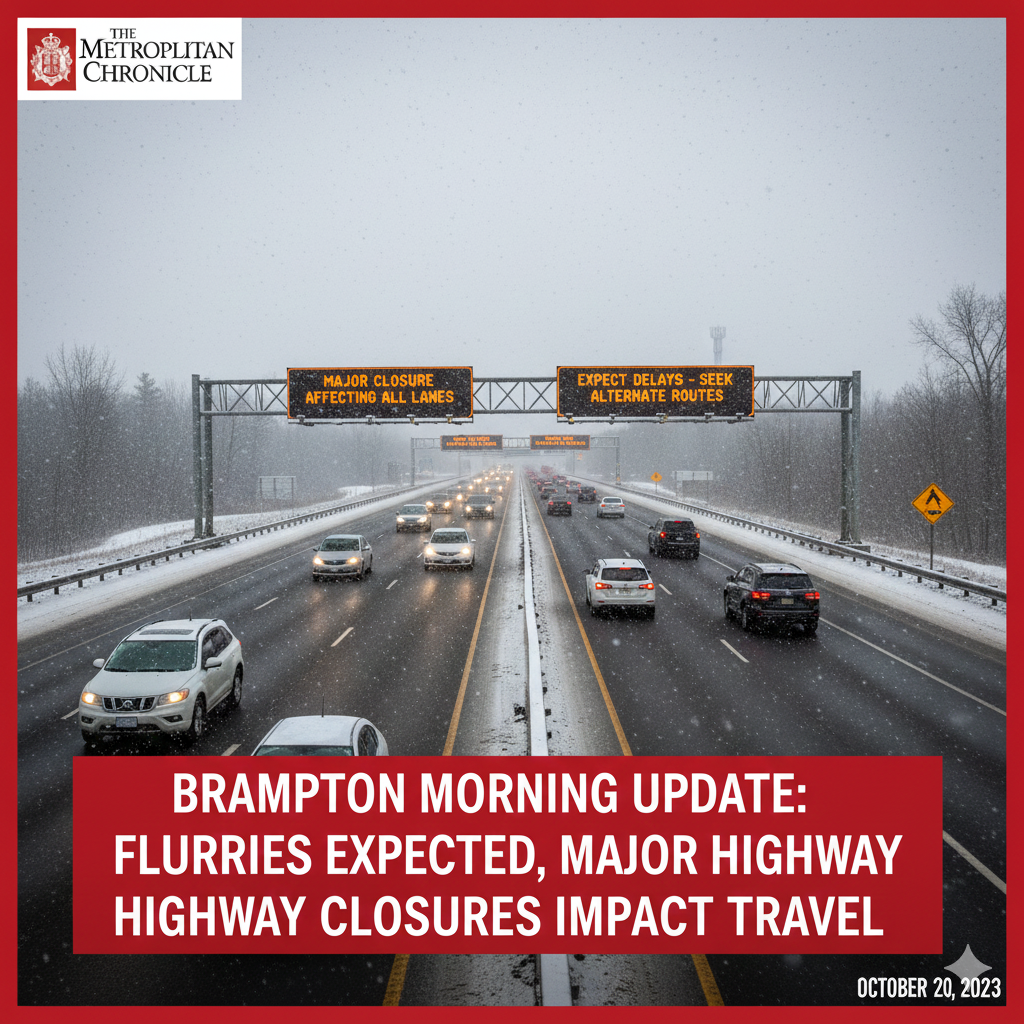
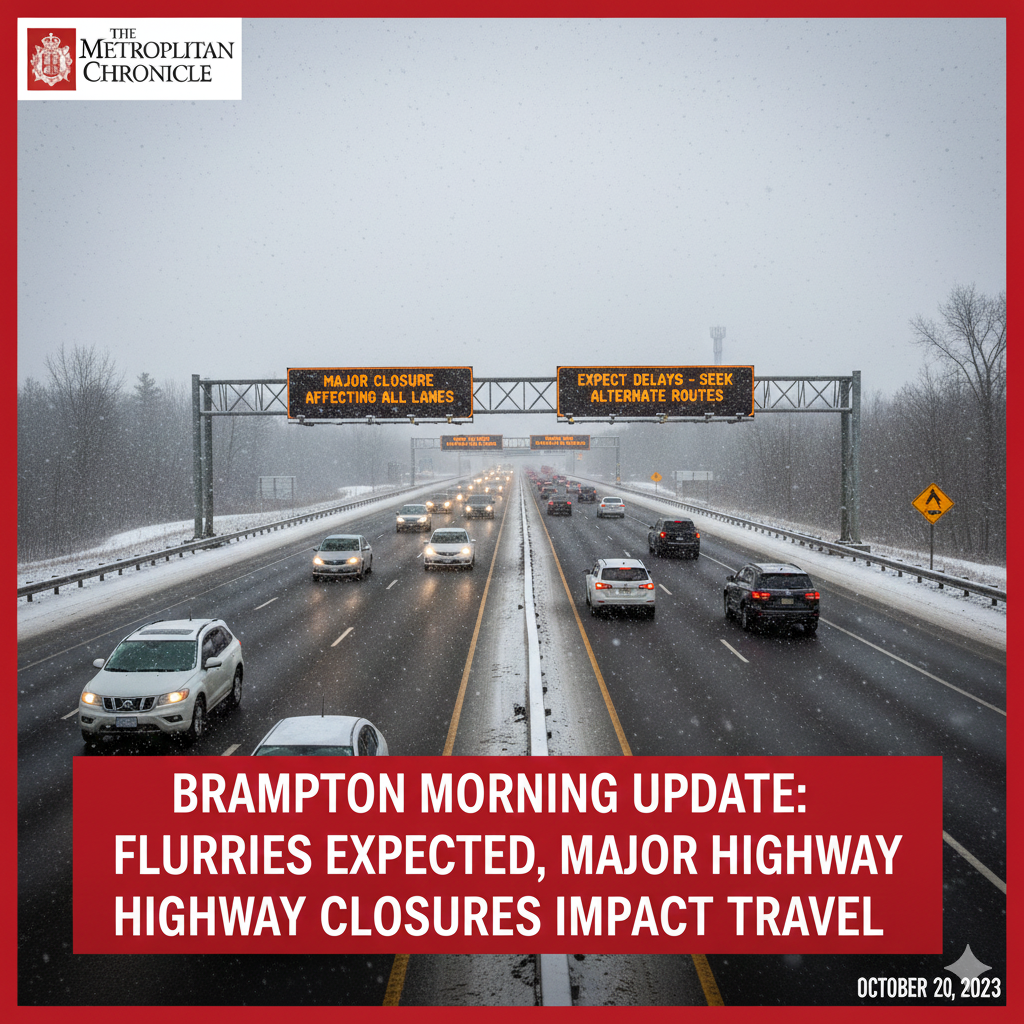
Brampton Morning Update: Flurries Expected, Major Highway Closures Impact Travel on December 20

Brampton residents are waking up to a wintery start this Saturday, with light snowfall possible and several significant highway closures affecting travel across the region. As the city eases into the weekend, weather conditions, road disruptions, and key local updates are shaping the day ahead. Here is a comprehensive look at Brampton’s weather forecast, traffic situation, and what residents should know to plan their Saturday safely and efficiently.

Winter Weather Returns to Brampton

Environment Canada is forecasting a chilly December morning for Brampton, with the possibility of flurries developing during the early hours of the day. While snowfall is not expected to be heavy, even light flurries can affect visibility and road conditions, particularly during the morning commute.

Cold Temperatures and Light Snow Risk

According to the forecast, Brampton’s daytime high is expected to reach approximately 1°C. Temperatures hovering around the freezing mark increase the likelihood of icy patches forming on untreated roads, sidewalks, and driveways. Residents are advised to exercise caution when walking or driving, especially in shaded areas where ice can linger longer.

There is a 30 per cent chance of precipitation, meaning snowfall may be intermittent and localized rather than widespread. However, even brief flurries can create slick conditions, particularly when combined with existing moisture on road surfaces.

What This Means for Residents

For those heading out early, warm clothing and winter footwear are recommended. Drivers should allow extra time for their journeys, maintain safe following distances, and remain alert for sudden changes in road conditions. While this is not expected to be a major snow event, December weather can be unpredictable, and conditions may change quickly.

Major Highway Closures Affecting the Region

In addition to the weather, several key highways in and around Brampton are experiencing closures or disruptions, adding another layer of complexity to weekend travel plans.

Highways Impacted by Closures

Motorists are being advised to watch for closures on the following major routes:

  • Highway 10

  • Highway 403

  • Highway 427

  • Queen Elizabeth Way (QEW)

These highways are critical transportation corridors for commuters and weekend travelers throughout the Greater Toronto Area. Closures may be due to scheduled construction, maintenance work, or safety-related issues, all of which can be intensified by winter weather conditions.

Traffic Delays and Detours Expected

With multiple highways affected, traffic congestion is likely, particularly during peak travel hours. Drivers should expect slower-moving traffic, reduced lanes, and possible detours. Navigation apps and local traffic updates can help identify alternate routes, but patience will be essential.

Public transit users may also experience delays if buses are rerouted or slowed due to road conditions. Transit riders are encouraged to check schedules and service alerts before departing.

Preparing for Safe Travel Today

Tips for Drivers

  • Check road and traffic updates before leaving home

  • Reduce speed and avoid sudden braking

  • Keep headlights on during flurries for better visibility

  • Ensure winter tires are in good condition

Advice for Pedestrians

  • Wear footwear with good traction

  • Watch for icy sidewalks and crosswalks

  • Allow extra time to reach destinations safely

Being proactive can help reduce the risk of accidents and delays during winter conditions.

Local News Snapshot: Staying Informed This Saturday

While weather and traffic are top of mind today, staying connected to local news remains important for Brampton residents. Weekend updates often include community developments, public safety advisories, and municipal information that can impact daily life.

Community Awareness Matters

Morning updates like today’s briefing are designed to help residents start their day informed and prepared. Whether it is changing weather conditions, road disruptions, or emerging local stories, access to timely information helps the community respond effectively.

Residents are encouraged to follow trusted local news sources and official government channels for the most accurate and up-to-date information throughout the day.

Brampton’s Winter Routine in Full Swing

As December progresses, winter conditions are becoming part of daily life across Brampton. Light snowfalls, fluctuating temperatures, and road maintenance activities are expected to continue in the coming weeks.

City Preparedness and Seasonal Adjustments

Municipal crews remain on standby to address road safety concerns, including salting and plowing when necessary. Residents may notice increased roadwork activity as crews work to maintain safe travel conditions amid changing weather.

For homeowners and businesses, this is also a reminder to clear sidewalks and entrances as required, helping ensure pedestrian safety across neighbourhoods.

Looking Ahead: What to Expect Later Today

While the morning may bring flurries, conditions are expected to remain relatively stable as the day progresses. No major storms are currently forecast, but cloudy skies and cold temperatures are likely to persist.

Those planning outdoor activities should dress warmly and remain mindful of changing conditions. For indoor plans, today’s weather serves as a reminder that winter has firmly settled in, making it a good day to stay informed, drive cautiously, and enjoy the slower pace of a Saturday.

Conclusion: A Cautious Start to the Weekend

Saturday, December 20, begins with light winter conditions and notable transportation challenges for Brampton residents. With a chance of flurries, temperatures near freezing, and closures on several major highways, planning ahead is essential.

By staying informed, allowing extra travel time, and taking appropriate safety precautions, residents can navigate the day with confidence. As always, local updates provide valuable insight into weather, traffic, and community developments, helping Brampton start the weekend prepared and connected.

Inside a Defining and Difficult Era for Canada Basketball

Long before packed NBA arenas, global superstars, and Olympic medal dreams became part of Canada’s basketball identity, the sport in this country existed on the margins—underfunded, overlooked, and deeply divided. The early 1990s represented both a turning point and a painful reckoning for Canada Basketball, as ambition collided with reality during a period marked by growth, missteps, and uncomfortable truths.

At the centre of this turbulent era was the 1994 FIBA World Championship, an event that was supposed to announce Canada’s arrival on the global basketball stage. Instead, it exposed structural weaknesses, cultural fractures, and longstanding issues that would take decades to confront.


How Canada Ended Up Hosting the World

The tournament was never meant to come to Canada. Originally scheduled for Belgrade, the championship was relocated after war broke out in Yugoslavia in the early 1990s. With limited options available, FIBA reached out to Canadian businessman John Bitove, asking whether Canada could step in.

Bitove saw opportunity—but only if the event carried global relevance. The success of the 1992 Barcelona Olympics, where NBA professionals formed the iconic U.S. Dream Team, had transformed basketball’s international appeal. Bitove believed Canada could not attract fans, sponsors, or legitimacy without NBA participation.

After securing approval from NBA commissioner David Stern, Canada won the bid. A committee raised roughly $13 million to stage the tournament across Toronto and Hamilton, using massive venues like SkyDome and Maple Leaf Gardens.

Against the odds, the event was a commercial success. Hundreds of thousands of tickets were sold, and Canada Basketball—an organization on the brink of financial collapse—received a share of the profits that ensured its survival.

The ripple effects were historic. Within a year, Bitove leveraged those relationships to help bring the Toronto Raptors into existence. In many ways, the world championship laid the foundation for Canada’s NBA future.


A Young Star Emerges

On the court, the tournament marked the first major international moment for a 20-year-old Steve Nash. Playing in his first senior event, Nash showed flashes of creativity and confidence that hinted at what was to come.

Though he was not yet a star, his style stood out. While much of the roster focused on structure and discipline, Nash brought flair, vision, and unpredictability—qualities that would later define Canadian basketball’s modern identity.

Despite that promise, Canada’s performance disappointed. The team finished seventh, failing to reach the quarterfinals on home soil. Losses to teams like Russia and Greece fueled criticism and amplified scrutiny.

For many observers, the problem was not effort, but identity.


An Embarrassing Atmosphere at Home

One of the most uncomfortable moments of the tournament had little to do with the scoreboard.

In several games, Canadian fans were visibly outnumbered by supporters of opposing teams. Flags from Greece, Russia, and other nations filled the stands, creating a jarring scene for a host country. The lack of home support became a national talking point.

For longtime basketball observers, it symbolized how disconnected Canada was from its own national program. Basketball simply did not command the attention hockey did, and without an NBA presence, the sport struggled to capture mainstream interest.

Players noticed the difference immediately. Some recalled being recognized and celebrated overseas, only to be virtually anonymous at home. The contrast was stark—and demoralizing.


A System Built on Control, Not Creativity

Behind the scenes, deeper issues were unfolding.

Head coach Ken Shields ran a centralized national team program based in Victoria, heavily influenced by his success coaching university basketball. His philosophy prioritized discipline, fitness, and execution. It worked in a limited context, producing solid teams and professional opportunities for some players.

But it also narrowed the pipeline.

The roster was dominated by athletes from Western Canada and university programs, while emerging talent from Toronto and Montreal—cities experiencing explosive growth in Black and immigrant communities—was often overlooked.

Former coaches and players later described the teams of that era as overwhelmingly white, reflecting not just demographics but selection bias. While basketball culture was evolving rapidly in urban centres, the national program remained rooted in an older model.


East vs. West: A Cultural Divide

By the early 1990s, basketball power in Canada was shifting eastward.

Toronto and Montreal high schools were producing athletes with speed, creativity, and an improvisational style influenced by streetball and outdoor courts. These players played above the rim, thrived in chaos, and brought flair to the game.

It was a sharp contrast to the structured, methodical approach favoured by the national program.

The divide wasn’t just tactical—it was cultural. Urban players often felt misunderstood or undervalued, while selectors viewed their style as risky or undisciplined. This disconnect prevented Canada from fully tapping into its growing talent base at a critical moment.


Allegations and Uncomfortable Questions

As years passed, former players and coaches became more vocal about the racial dynamics of that era.

Some described systemic barriers that limited opportunities for Black athletes, not through overt exclusion, but through preferences that favoured certain backgrounds, coaching trees, and playing styles. Others pointed to a lack of diversity in leadership roles and decision-making positions.

These conversations were largely absent from public discourse at the time. Basketball did not yet command enough national attention to force accountability. But the consequences were clear: Canada lagged behind countries that embraced change faster.


Seeds of the Golden Generation

Ironically, the very failures of the early 1990s planted the seeds for future success.

The arrival of the Raptors and Vancouver Grizzlies in 1995 transformed basketball’s visibility. Young players finally had role models wearing Canadian jerseys in the NBA. Urban courts became incubators of talent rather than afterthoughts.

Steve Nash’s eventual rise to MVP status reframed what Canadian basketball could be. His success challenged old assumptions and proved that creativity and intelligence could coexist at the highest level.

Over time, Canada Basketball began to modernize—slowly expanding its talent identification, diversifying leadership, and embracing the country’s changing demographics.


A Necessary Reckoning

Looking back, the 1994 FIBA World Championship stands as both a triumph and a cautionary tale.

It saved an organization financially, sparked the birth of an NBA franchise, and introduced a generation to international basketball. But it also revealed how unprepared Canada was to fully support, represent, and understand its own players.

The embarrassment, the criticism, and the internal conflicts forced a long-overdue reckoning—one that would eventually shape the inclusive, globally respected program Canada boasts today.

The golden generation did not emerge overnight. It was forged through missteps, missed opportunities, and difficult conversations that began during one of the most turbulent periods in the sport’s history.

Realtors Impacted by iPro Realty Scandal to Receive Half of Frozen Commissions

Florez is part of a group representing roughly 250 affected agents, many of whom have been waiting months for commissions tied to completed transactions. She says the group plans to formally raise concerns with both RECO administrator Jean Lépine and Premier Doug Ford, arguing that the current compensation structure unfairly shifts the burden of brokerage failure onto individual realtors.


What RECO Is Saying

In a public advisory issued Dec. 15, Lépine said RECO’s priority has been to accelerate payments through the Commission Protection Insurance Program, administered by Alternative Risk Services.

“This event is larger in scope and size than any that has occurred in 25 years of the insurance program,” the insurer said, noting that total commission losses are projected to reach approximately $30 million.

According to Alternative Risk Services, the combination of:

  • $4 million in insurance coverage, and

  • Funds expected to be recovered from frozen iPro accounts

is only sufficient to cover about half of the total commission claims.

Lépine emphasized that consumer protection was also a key concern, adding that approximately $5 million in consumer deposit claims have already been paid out, ensuring buyers and sellers were not financially harmed by the brokerage’s collapse.


Why Only 50 Per Cent?

At the heart of the dispute is how commission protection insurance is structured in Ontario.

Real estate agents are required to pay into an insurance program designed to protect both consumer deposits and realtor commissions in the event of brokerage insolvency or misappropriation. However, agents do not control trust accounts and have no authority over how brokerages manage funds.

“That’s the fundamental injustice here,” Florez said. “Realtors are paying for insurance to cover risks they don’t create and can’t control.”

Insurance limits, combined with the scale of losses at iPro, mean that even when the insurance is triggered, agents are effectively competing for a limited pool of funds—often after consumer claims are prioritized.


The iPro Timeline

According to an audit report cited by provincial officials, iPro Realty first disclosed a $10 million shortfall in trust accounts to RECO on May 19. However, the regulator did not publicly disclose the issue until August 14, when it announced the brokerage would terminate its registration and close on Aug. 19.

By that point, RECO moved to freeze all iPro accounts, a step intended to safeguard remaining funds but one that also prevented commissions from being released without a court order.

“Once a freeze order is in place, outstanding funds can be deposited, but no funds can be released without evidence of loss and court authorization,” Lépine explained.

That freeze sparked a wave of protests by agents across the Greater Toronto Area, with demonstrators demanding immediate access to earned commissions.


Provincial Takeover of RECO

The scale of the scandal prompted the Ontario government to take over RECO, appointing Lépine as administrator effective Dec. 1.

An independent audit concluded that RECO’s registrar had deviated from standard regulatory practices in responding to the iPro situation, raising concerns about delayed intervention and oversight failures.

For affected agents, those findings only deepen frustration.

“If regulatory failures contributed to the size of this loss,” Florez argued, “then RECO should be financially responsible for ensuring commissions are paid in full.”


Agents Say System Is Fundamentally Unfair

In a written statement, Florez questioned why individual realtors—many of whom are independent contractors—bear the financial consequences of brokerage misconduct.

“If brokerages are the custodians of trust funds, why are they not bearing the full cost of the insurance that protects against their own failures?” she asked.

Agents say the current system leaves them:

  • Waiting months for payment

  • Receiving partial compensation

  • Absorbing financial losses despite completing transactions

Many report having mortgages, staff salaries, marketing expenses and personal obligations that continued while their income was frozen.


Broader Impact on the Industry

iPro Realty employed approximately 2,400 agents and operated 17 locations across Ontario, including Mississauga, Brampton, Burlington, Milton, Georgetown, Woodbridge, Orangeville and Pickering.

Industry observers say the scandal has shaken confidence in brokerage oversight and raised questions about whether insurance limits and regulatory safeguards are adequate for large, modern brokerages.

“This case exposed vulnerabilities that have existed for years,” said one real estate governance expert. “The system was designed for smaller failures, not multi-million-dollar collapses.”


What Happens Next?

For now, agents will begin receiving half of their owed commissions, with no guarantee the remaining balance will ever be paid.

Florez and other agents say they will continue pushing for:

  • Full commission repayment

  • Regulatory reform

  • A review of insurance funding structures

  • Clear accountability for oversight failures

“This isn’t just about iPro,” Florez said. “It’s about protecting every realtor in Ontario from going through this again.”


Conclusion

The decision to release 50 per cent of frozen commissions marks a significant but controversial step in resolving one of Ontario’s largest real estate scandals.

While regulators emphasize consumer protection and financial limitations, affected agents argue the solution leaves them unfairly penalized for failures beyond their control.

As partial payments roll out, the iPro scandal continues to raise uncomfortable questions about accountability, insurance adequacy and who ultimately pays the price when brokerage oversight breaks down.