
Inside a Defining Era for Canada Basketball: Controversy, Cultural Shifts, and the Road to Reinvention

Introduction: A Program at a Crossroads

Canada Basketball did not become a global basketball force overnight. Its rise was shaped by moments of triumph, missteps, cultural tensions, institutional decisions, and an evolving national identity. The mid-1990s, often remembered for the arrival of the Toronto Raptors and the blossoming of Steve Nash, also represented one of the most turbulent eras in the program’s history.

That period—marked by allegations of racial bias, internal fractures, and a rapidly changing basketball landscape—formed the backbone of a transformation that would ultimately reshape the sport in Canada. This rewritten report traces the events described in The Golden Generation: How Canada Became a Basketball Powerhouse, offering an in-depth look at the turning points that pushed the program toward accountability and change.

A Tournament That Changed Everything

Hosting the 1994 FIBA World Championship

The 1994 FIBA World Championship was never meant to be held in Canada. Belgrade, Serbia, had originally secured hosting rights, but Yugoslavia’s civil war forced FIBA to reopen the bidding process. That’s when Canadian businessman John Bitove received a call from FIBA head Boris Stankovic asking whether Canada might step in.

Bitove agreed on one condition: NBA players had to be allowed to participate. That decision was directly inspired by the enormous success of the 1992 Barcelona Olympics, which introduced the world to the U.S. Dream Team—Michael Jordan, Magic Johnson, Larry Bird, and other NBA stars who redefined basketball as a global spectacle.

To make his case, Bitove contacted NBA commissioner David Stern. Stern’s response was clear: professional players would participate only if the tournament were held in North America. With that, Bitove joined forces with Canada Basketball CEO Rick Traer, raising $13 million to win the hosting bid.

Their gamble paid off. More than 330,000 tickets were sold—an event record—and the gold-medal game at Toronto’s SkyDome attracted 32,000 fans. Canada Basketball even secured 40 per cent of the profits, revenue that kept the financially strained organization afloat.

The Raptors Connection

The success of the tournament gave Bitove the credibility he needed to pursue an NBA expansion franchise. One year later, in 1993, he became the founding owner of the Toronto Raptors. As he later acknowledged, “Without the ’94 worlds, I wouldn’t have had the NBA team.”

The Arrival of Steve Nash

A Young Guard Steals the Spotlight

The tournament also marked the international debut of a rising star: 20-year-old Steve Nash. Though the team’s focus had initially been on showcasing Rick Fox, then Canada’s only NBA player, Nash’s playmaking quickly became the talk of the competition. His average of seven points, three assists, three rebounds, and two steals in 23 minutes per game hinted at the potential of a future MVP.

But even Nash’s emergence could not mask the team’s struggles. Canada finished seventh in the 16-team field, falling short of expectations in front of a home crowd hungry for a breakthrough. Journalists called the performance disappointing, and missing the quarterfinals amplified the criticism.

Fan Disengagement and Cultural Realities

Cheering for the Opposition

Despite strong attendance numbers, something unusual happened throughout Canada’s games: the cheers were louder for opposing teams. A notable matchup against Greece drew far more Greek flags than Canadian ones, prompting broadcaster Don Cherry to deliver one of his trademark rants about Canadian crowd loyalty.

For many players, however, the phenomenon made sense. Toronto, Hamilton, and Montreal were home to large immigrant communities with deep basketball traditions. Supporters turned out in droves to cheer for their countries of origin, a reflection of Canadian multiculturalism. Yet for national team veterans like Doug Smith, it was jarring. He called it “one of the most embarrassing sports events I’ve ever been at.”

Basketball’s Fight for Respect

The lack of mainstream support was not new. Before the Raptors and Vancouver Grizzlies arrived in 1995, basketball remained fringe in many parts of the country. Players like Jay Triano and Eli Pasquale often said they were recognized internationally but ignored at home. During the 1986 world championship in Madrid, they were chased into stores by fans seeking autographs. Weeks earlier in Ottawa, a bar bouncer refused them entry—unaware they were national team athletes.

Coaching Philosophy and a Brewing Divide

Ken Shields and the Victoria-Centred System

Beneath the surface, deeper tensions were forming around head coach Ken Shields’ approach. When Shields took over in 1989, he centralized the national program in Victoria, British Columbia, relying heavily on his network and the training infrastructure he built there. Players lived year-round in Victoria, trained full-time, and adopted a methodical, half-court style inspired by John Wooden.

This system produced disciplined teams but clashed with the evolving demographics of Canadian basketball. A surge of talent was emerging from Toronto and Montreal—players influenced by outdoor court culture, fast-paced streetball, and a more improvisational style. Many of these athletes believed Shields’ system not only failed to highlight their strengths but created barriers to making the national team.

Allegations of Racial Bias

By the mid-1990s, frustration reached a boiling point. In 1994, the Globe and Mail published an explosive article titled Toronto Blacks Assail Basketball Canada, featuring allegations that Shields’ roster decisions were influenced by racial bias.

Two standout players—Cordell Llewellyn and Wayne Yearwood—claimed they were cut not for performance reasons but because of preconceived notions about Black athletes. Llewellyn argued that the national team appeared to associate “Canada” with whiteness, while Yearwood criticized Shields’ inability to understand or fully utilize the talent available.

The article triggered public outrage and prompted Canada Basketball to request an external review led by diplomat Cal Best and overseen by Sport Canada.

The Review and Its Aftermath

Findings and Recommendations

The investigation interviewed more than 60 people. Ultimately, the report concluded that race did not play a role in team selection. However, it issued 11 significant recommendations aimed at modernizing the program, including:

  • separating the roles of coach and program director

  • recruiting more minority coaches

  • creating broader open tryouts across Canada

Shields later sued the Globe and Mail, which settled and issued a retraction. He described the ordeal as deeply painful.

Long-Term Impact

Although the review cleared Shields of racism, it highlighted structural deficiencies within Canada Basketball—deficiencies many players felt disproportionately affected Black athletes. These concerns resurfaced repeatedly into the 21st century, revealing a lingering distrust rooted not in one individual’s actions but in decades of institutional culture.

Conclusion: A Complicated Legacy

The turbulent era of the early 1990s left a lasting imprint on Canada Basketball. The hosting of the 1994 FIBA World Championship sparked national interest, helped launch the Raptors, and introduced Steve Nash to a global audience. Yet behind the scenes, cultural divides, allegations of systemic bias, and shifting demographic realities forced the organization to confront its shortcomings.

Today, the program features diverse leadership, transparent selection processes, and rosters built purely on merit. But the legacy of that difficult chapter remains part of the sport’s history—an essential reminder of how far Canada Basketball has come and how much was learned along the way.

Major Highway Closures to Slow Traffic Across Peel on Dec. 12: Drivers Urged to Plan Ahead

As winter weather, seasonal maintenance and infrastructure upgrades converge across the Greater Toronto Area, Peel Region drivers are being advised to brace for a full slate of highway disruptions on Thursday, Dec. 12, 2025. A total of 16 scheduled closures will affect key routes in Mississauga, Caledon and surrounding communities—potentially impacting commuters, commercial drivers and holiday travellers alike.

The Ministry of Transportation of Ontario (MTO) has confirmed that these closures are part of ongoing repair, rehabilitation and safety-enhancement projects across several of the busiest highways in the region. While most of the restrictions involve alternating lane closures during overnight or off-peak hours, transportation officials warn that motorists should expect delays and plan alternate routes wherever possible.


A Busy Week for Road Maintenance Across Peel

Why These Closures Matter

Peel Region’s highways form some of the most heavily travelled corridors in Ontario, carrying significant volumes of passenger and commercial traffic daily. December is also a period when routine maintenance intersects with weather-related repairs, forcing the province to accelerate work before winter conditions worsen.

The combination of lane reductions, ramp closures and overnight restrictions is designed to minimize daytime disruption. However, with multiple closures overlapping across Highway 401, Highway 403, Highway 10 and the Queen Elizabeth Way (QEW), the cumulative impact is expected to be noticeable throughout the week.


Breakdown of Major Highway Restrictions

Below is a detailed look at the scheduled Dec. 12 closures, including timelines, affected stretches and what drivers should anticipate.

Highway 403 Closures

Highway 403—one of Mississauga’s most critical east–west arteries—will experience repeated lane impacts this week.

Eastbound Between Highway 407 and Mavis Road

  • Three alternating lanes closed

  • Dec. 15 at 9 p.m. – Dec. 20 at 5 a.m.

This extensive eastbound lane reduction could cause delays extending toward the 401/403 interchange, one of the GTA’s well-known congestion points.

Multiple Eastbound Off-Ramp Restrictions Near Highway 401

Three separate closures will affect the eastbound off-ramp south of Highway 401 in Mississauga:

  • Dec. 10 at 10 p.m. – Dec. 13 at 6 a.m.

  • Dec. 11 at 10 p.m. – Dec. 13 at 6 a.m.

  • Dec. 15 at 10 p.m. – Dec. 20 at 6 a.m.

Alternating lane closures on this busy connector ramp may slow overnight traffic and impede access to nearby commercial and industrial districts.

Additional Eastbound Lane Closure

  • Dec. 6 at 9 p.m. – Dec. 14 at 5 a.m.

  • Three alternating lanes closed

With multiple closures overlapping along Highway 403, drivers using the route this week are encouraged to allow extra travel time and watch for sudden slowdowns.


Highway 10 Closures in Caledon

Motorists travelling north–south through Caledon will encounter several closures along Highway 10, which serves as a major rural and commuter corridor.

Southbound Between Forks of the Credit Rd. and Old School Rd.

  • One alternating lane closed

  • Dec. 8 at 9 a.m. – Dec. 15 at 5 a.m.

A second, extended closure follows:

  • Dec. 15 at 9 a.m. – Dec. 22 at 5 a.m.

These daytime and overnight closures may create bottlenecks in an area where alternate routes are limited.

Northbound Between Old School Rd. and Forks of the Credit Rd.

Two separate northbound restrictions will also be active:

  • Dec. 8 at 6 p.m. – Dec. 15 at 3 p.m.

  • Dec. 15 at 6 p.m. – Dec. 22 at 3 p.m.

These alternating lane closures may impact commuters heading toward Orangeville and surrounding rural areas.


Queen Elizabeth Way (QEW) Closures

The QEW—linking Toronto, Mississauga and the Halton region—will see some of the longest-lasting lane restrictions this month.

Toronto-Bound Between Cawthra Rd. (Mississauga) and West Mall/Evans Ave. (Toronto)

  • Two alternating lanes closed

  • Nov. 23 at 10 p.m. – Dec. 14 at 5 a.m.

  • A second closure from Dec. 3 at 9 p.m. – Dec. 14 at 5 a.m.

These overlapping restrictions, approaching one of the GTA’s most heavily travelled QEW stretches, may generate traffic backups especially near downtown Toronto commuters.

Toronto-Bound Between Winston Churchill Blvd. (Oakville) and Highway 10/Hurontario (Mississauga)

  • Two alternating lanes closed

  • Dec. 7 at 10 p.m. – Dec. 13 at 5 a.m.

This section often experiences nighttime construction due to ongoing rehabilitation work on bridges and pavement structures.

Toronto-Bound Between Erin Mills Pkwy./Southdown Rd. and Highway 10/Hurontario

  • Two alternating lanes closed

  • Dec. 17 at 10 p.m. – Dec. 19 at 5 a.m.

These closures are expected to cause delays near Mississauga Road and areas with active interchange construction.

Fort Erie-Bound Between Highway 10/Hurontario and Mississauga Rd.

  • Two alternating lanes closed

  • Dec. 7 at 11 p.m. – Dec. 12 at 6 a.m.

Southbound travellers heading toward Burlington or Niagara should exercise caution during overnight hours.

Fort Erie-Bound Between Erin Mills Pkwy./Southdown Rd. and Erin Mills Pkwy./Southdown Rd.

  • Right lane closed

  • Dec. 9 at 10 p.m. – Dec. 12 at 5 a.m.

This short but frequently travelled segment will experience reduced capacity during late evening and early-morning intervals.


Highway 401 Closure

Highway 401—Canada’s busiest highway—will see one scheduled closure affecting westbound drivers.

Westbound Between Dixie Rd. and Highway 410

  • One alternating lane closed

  • Dec. 15 at 11 p.m. – Dec. 18 at 5 a.m.

While the closure is limited to overnight hours, congestion may still build due to high truck traffic volumes.


How These Closures Are Managed

Coordination Between MTO and Municipal Partners

Transportation officials note that work schedules are carefully selected to balance construction needs with the region’s substantial daily traffic. Overnight windows are typically chosen to minimize disruption, but winter weather and emergency repairs may force last-minute changes.

Potential for Weather-Related Adjustments

As with all winter-season maintenance, the Ministry of Transportation warns that closure timelines may shift due to:

  • Snowfall and ice conditions

  • Emergency repair requirements

  • Equipment delays

  • Safety considerations for on-site crews

Motorists are strongly encouraged to regularly check updates through Ontario 511, local traffic media and navigation apps that provide real-time construction alerts.


Tips for Drivers Navigating the Closures

Plan Ahead to Reduce Delays

With closures spread across multiple major highways, drivers can take several steps to minimize travel disruption:

  • Check live traffic information before leaving home

  • Allow extra time, especially for morning or evening travel

  • Use alternate routes where available

  • Drive cautiously near construction zones and obey reduced speed limits

Even if lane closures appear short, the cumulative effect across Peel’s major corridors may contribute to heavier congestion, particularly for commuters heading into Toronto or across Halton Region.


Understanding the Broader Purpose

This round of scheduled lane closures is part of Ontario’s ongoing strategy to maintain and modernize critical highway infrastructure. With aging bridges, high traffic volumes and expanding communities placing greater pressure on the road network, proactive repairs remain essential to keep routes safe and efficient.

The Ministry notes that while closures are inconvenient in the short term, they are vital to preventing deterioration that could require longer-term shutdowns in the future.


Conclusion: Expect a Slower Commute and Stay Informed

With 16 separate highway closures scheduled across Peel Region on Dec. 12, drivers can expect slower travel and shifting traffic patterns throughout the week. While most restrictions target overnight hours, the ripple effects may still touch both rush periods and commercial routes. Motorists are encouraged to prepare accordingly, make use of real-time traffic tools and stay aware of evolving conditions as winter repairs continue.

If your travel takes you beyond Peel, additional closures are listed through Ontario 511 to help drivers plan longer trips across the province.

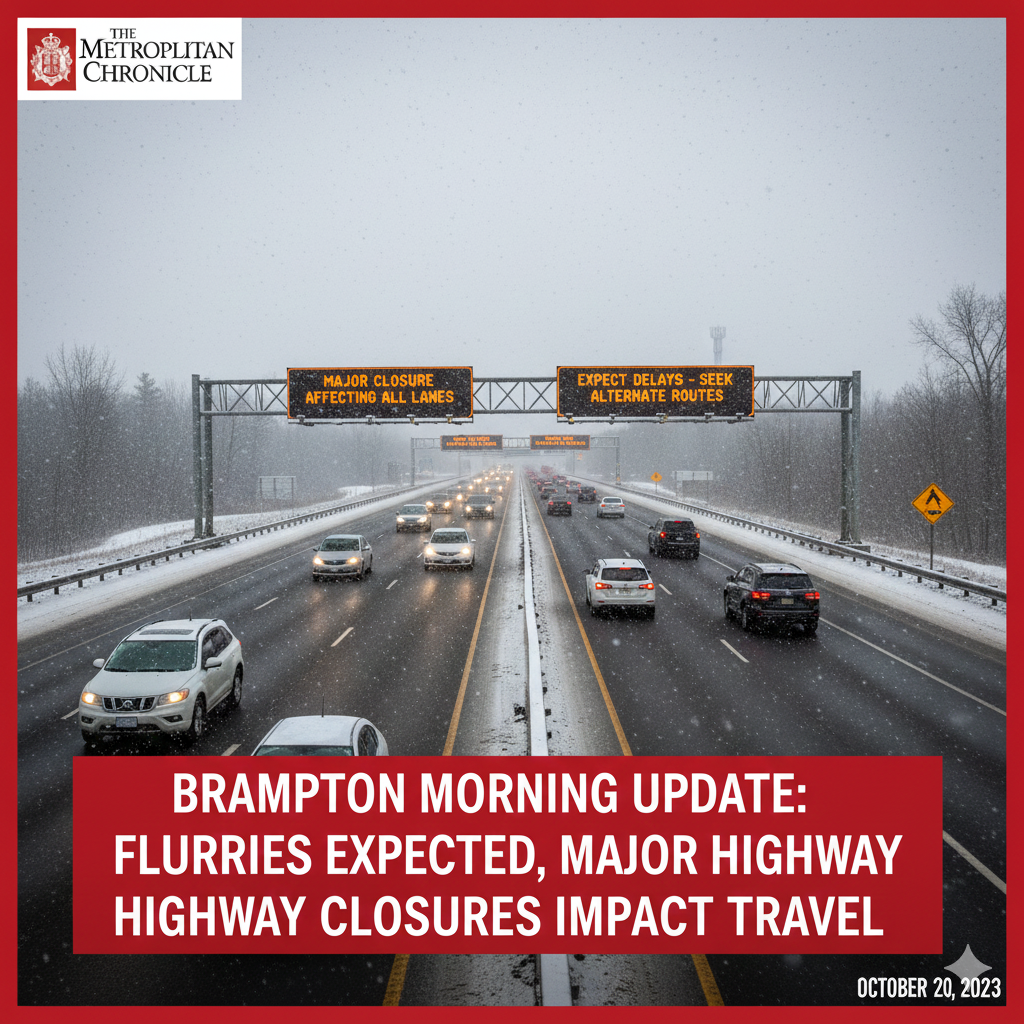
Brampton Weather Outlook, Highway Disruptions, and Key Updates for December 12

As Brampton residents start their Friday morning, a mix of early-winter weather conditions, ongoing highway closures, and developing local news stories are shaping the day ahead. With temperatures hovering around the freezing mark and a blanket of cloud cover settling over the region, commuters and residents are being advised to stay alert to both road conditions and expected evening flurries.

This comprehensive update provides a detailed look at today’s weather forecast, the latest traffic disruptions across major highways, and the essential information residents need to begin their day well-informed.


A Cloudy and Cold Start to the Day

Morning Temperatures Hovering Around Freezing

Environment Canada is forecasting a mainly cloudy sky across Brampton this morning, creating a cold but typically seasonal December atmosphere. Daytime temperatures are expected to reach a high of 0°C, offering little opportunity for melting on surfaces that froze overnight.

The thick cloud cover is expected to persist through the afternoon, creating a dull, grey backdrop across the city as residents head to work, school, and early weekend errands. While no significant precipitation is anticipated during daytime hours, the cold temperatures continue to pose the risk of slick roads, especially in shaded or elevated areas.

Evening Flurries Expected Across the Region

As the day transitions into night, Brampton will see a shift in conditions with light flurries forecasted after sunset. Temperatures are projected to drop to –6°C, creating ideal conditions for snow to accumulate on untreated roads and sidewalks.

Drivers are advised to proceed with caution, particularly during late-evening commutes, as visibility may fluctuate due to intermittent flurries. With temperatures expected to stay below freezing overnight, icy patches may develop and persist into the next morning.


Major Highway Disruptions Impacting Commuters

Closures on Highway 10 and Surrounding Routes

Several major highways in and around Brampton are experiencing closures and traffic disruptions today. Authorities have confirmed that sections of Highway 10 remain closed due to ongoing maintenance operations and weather-related safety concerns. Commuters relying on this corridor should anticipate delays and consider alternative routes where available.

Highway 401: Delays Expected Through Key Sections

One of the region’s busiest roadways, Highway 401, is also facing closures along select stretches. These disruptions are expected to significantly affect travel times during both the morning and afternoon rush hours. With temperatures at or below freezing, crews are monitoring road conditions closely to address icy buildup and ensure driver safety.

Highway 403 and QEW: Ongoing Restrictions

In addition to the 401 and Highway 10, both Highway 403 and the Queen Elizabeth Way (QEW) are experiencing partial closures. These restrictions stem from a combination of scheduled maintenance, collision cleanup, and precautionary weather-related measures.

Motorists should monitor real-time traffic updates and plan trips accordingly, particularly those who travel between Brampton, Mississauga, Oakville, and surrounding areas. Transit riders may also experience delays if buses are rerouted due to closures or reduced traffic flow.


Weather and Traffic Conditions Shape the Day Ahead

Impact on Schools, Workplaces, and Local Travel

With temperatures remaining low and evening flurries in the forecast, today’s conditions may affect school schedules, workplace planning, and local travel routines. Residents are advised to dress in warm, layered clothing and allow extra time for their commute, especially during peak periods.

School transportation services are operating normally but are encouraging families to be prepared for potential delays, particularly on rural routes or those passing through construction zones and affected highways.

Tips for Staying Safe During Winter Travel

Given the combination of cold temperatures, cloud cover, and the likelihood of nighttime flurries, safety experts are reminding residents to:

  • Check weather and traffic apps before leaving home.

  • Give yourself additional time for travel.

  • Keep vehicle fuel tanks at least half full during winter.

  • Ensure winter tires are properly inflated and in good condition.

  • Use headlights during cloudy or low-visibility conditions.

  • Maintain a safe following distance on potentially icy roads.

These simple precautions can significantly reduce the risk of collisions and improve road safety for both drivers and pedestrians.


Community Updates and Headlines to Watch Today

Local News Highlights

While weather and traffic dominate the morning headlines, Brampton residents can also expect updates on several developing local stories throughout the day. City officials are expected to release new information related to ongoing municipal projects, community programs, and public safety initiatives. More updates will be published as details become available.

Role of Public Data in Daily Briefings

Today’s daily briefing is compiled using open-source data, weather forecasts from Environment Canada, and real-time updates from provincial transportation authorities. This seamless integration of data helps provide residents with reliable, timely information to support safer travel and better planning throughout the day.


Looking Ahead: Weekend Weather Expectations

As Brampton moves closer to the weekend, residents should prepare for continued cold temperatures and the possibility of additional precipitation. Meteorologists are watching a weak system that may bring light snow or mixed precipitation early next week, though conditions remain subject to change.

The next 48 hours will see below-seasonal temperatures, making winter jackets, scarves, and gloves essential for anyone spending extended time outdoors.


Conclusion: Staying Prepared During Early Winter Conditions

This Friday brings a combination of cloudy skies, near-freezing temperatures, and significant highway closures that will influence the day’s flow across Brampton. With flurries expected tonight and a nighttime low of –6°C, residents should take steps to stay warm, remain aware of changing road conditions, and plan ahead for potential travel delays.

Whether heading out for work, school, or weekend preparations, staying informed remains the most effective way to navigate early winter weather safely. Continue to monitor updates from Environment Canada, provincial highway authorities, and local news sources for the latest information throughout the day.

Brampton Advances Citywide Traffic Overhaul with New ATMS and Future AI Integration

Introduction: A Major Step Toward Smarter Urban Mobility

The City of Brampton is entering a pivotal phase in its long-term transportation strategy as it rolls out a new Advanced Traffic Management System (ATMS) designed to modernize how traffic signals operate across the growing municipality. The system, expected to be fully operational by the end of the second quarter of 2026, aims to improve traffic flow, reduce congestion, and enhance road safety for motorists, cyclists, and pedestrians alike.

Alongside this upgrade, Brampton is also preparing to revisit the potential of adaptive artificial intelligence (AI) technologies—tools that can automatically adjust traffic signals based on real-time conditions. Although early trials of AI-based signal management were halted due to technical challenges, city officials say they remain optimistic about future implementation once the technology matures.

This major upgrade comes at a time when Brampton continues to expand rapidly and requires modern infrastructure capable of handling its increasing transportation demands.


Modernizing Brampton’s Traffic Infrastructure

Replacing an Outdated System

During a detailed presentation to Brampton City Council on November 26, Shane Loftus from the Public Works and Engineering Department emphasized that the city’s current traffic light system has reached the end of its functional lifespan.

According to Loftus, the ATMS being installed will serve as the “nervous system” of Brampton’s traffic operations—connecting sensors, communication hubs, and intersection controllers across the entire city.

Key Functions of the New ATMS

The upcoming system will introduce several capabilities absent from Brampton’s existing infrastructure:

  • Real-time monitoring of intersections

  • Remote signal adjustments by city staff

  • Centralized connectivity across all signalized intersections

  • Improved data accuracy for traffic analysis

  • Prebuilt capacity for future adaptive technologies

Loftus explained that once the system is established, traffic signals will be able to respond more intelligently to data inputs—from vehicle counts to pedestrian activity—enabling dynamic decision-making that can ease congestion and improve flow on major corridors.


Citywide Deployment Timeline

Phase 1: Priority Intersections and LRT Route

Brampton staff anticipate that initial installations will be completed throughout 2025, beginning with 16 intersections located along the future Hurontario LRT route. In addition, 292 high-priority intersections across the city will transition to the ATMS by the end of the first quarter of 2026.

These locations were selected based on traffic volume, transit use, safety considerations, and the need for advanced monitoring.

Phase 2: Full Network Integration

The remaining 292 intersections—many situated along major transit corridors—are expected to migrate to the system by the end of the second quarter of 2026.

Once completed, every signalized intersection in Brampton will operate within a unified digital environment, laying the foundation for potential AI-powered optimizations in the years to come.


Brampton’s Experience with Adaptive AI Technology

Early Pilots Show Promise but Face Limitations

Brampton was among the Canadian municipalities that began experimenting early with adaptive AI to determine whether such technology could automatically optimize traffic signal timings based on real-time conditions. Two pilot programs launched in 2023 and 2024 showcased both intriguing potential and significant technological challenges.

The 2023 Pilot: Williams Parkway and Graymar Road

The city installed cloud-based adaptive signal detection hardware and software to enhance pedestrian and cyclist safety at a busy trail crossing. The goal was to determine whether AI could accurately detect vulnerable road users and adjust signal timing accordingly.

The 2024 Pilot: Sandalwood Parkway and Chinguacousy Road

A second pilot introduced AI-powered video analytics and light detection technology for improved traffic flow and collision prevention. This intersection is historically busy, making it an ideal testing ground for advanced data collection systems.

Weather Challenges Lead to Cancellation

Despite promising early results, both pilot projects were ultimately discontinued. Loftus explained that factors such as heavy rain, snow, low visibility, and sun glare interfered with the technology’s accuracy—particularly in detecting and categorizing pedestrians, cyclists, and vehicles.

Because of these weather-related obstacles and limitations in existing AI models, the city concluded that it could not safely expand the pilot programs at that time.


Looking Ahead: Future of AI in Brampton’s Traffic Network

Renewed Interest Once Technology Evolves

City officials stress that the cancellation of earlier pilots does not indicate a lack of interest in AI-enhanced traffic management. Instead, Brampton is choosing a cautious approach, waiting for more reliable models and better hardware to emerge.

Loftus reaffirmed that once the new ATMS is deployed across a significant number of intersections—expected by mid-2026—the city will be positioned to revisit adaptive AI solutions.

Evaluating New Opportunities

Over the next year, Brampton will work closely with its technology vendors to:

  • Identify intersections most suitable for future AI pilots

  • Test newly developed adaptive algorithms

  • Assess improvements in detection accuracy and weather resilience

  • Explore cloud-based versus edge-based processing options

  • Prepare the network for advanced analytics and automation tools

With the foundational infrastructure nearly in place, the next generation of AI advancements may finally align with Brampton’s long-term traffic strategy.


Why ATMS and AI Matter for Brampton Residents

Making Roads Safer and More Efficient

As one of Canada’s fastest-growing cities, Brampton faces significant pressure on its transportation network. The new ATMS is expected to:

  • Reduce travel times on major corridors

  • Improve pedestrian and cyclist safety

  • Enhance emergency response coordination

  • Provide data to guide future infrastructure planning

  • Reduce emissions from idling vehicles

Supporting Transit Expansion

With major investments such as the Hurontario LRT underway, an upgraded traffic management system will ensure signals can integrate seamlessly with transit priorities, bus rapid transit corridors, and future mobility initiatives.


Conclusion: A Forward-Looking Vision for Traffic Management

Brampton’s decision to overhaul its traffic management infrastructure marks an important milestone in the city’s commitment to creating a safer, smarter, and more efficient transportation network. While early attempts to incorporate adaptive AI faced setbacks, city officials remain confident that continued advances in technology will eventually make these tools effective and reliable.

By mid-2026, with a citywide ATMS fully operational, Brampton will be well-positioned to launch new AI trials, gather high-quality data, and gradually move toward a future where traffic signals respond intelligently to real-time conditions. The transformation may be phased, but the direction is clear: Brampton is building a modern transportation system designed for a rapidly growing urban centre and the decades ahead.

Peel Region Sounds Alarm Over Deepening Social Services Funding Gap

Introduction: A Growing Region, A Shrinking Support System

Peel Region—home to Brampton, Mississauga, and Caledon—has long been known for its fast-paced growth, cultural diversity, and economic ambition. Yet beneath that upward trajectory lies a nagging question: Why are three of Ontario’s most dynamic cities receiving significantly less provincial support for essential community services than their counterparts?

That question took centre stage during Peel Region’s 2026 budget meeting on Dec. 4, where Metamorphosis, an umbrella advocacy group representing more than 100 local non-profits, warned of a staggering funding shortfall. Their message was clear and pointed: Peel residents are being underfunded by hundreds of millions of dollars each year, jeopardizing social services that many rely on daily.

As Mark Twain once joked, “Facts are stubborn things, but statistics are pliable.” In Peel’s case, however, the statistics are uncomfortably rigid—and impossible to ignore.

A Comprehensive Study Reveals the Depth of the Disparity

Findings Presented to Regional Council

Sean Meagher, co-ordinator of Metamorphosis, delivered a sobering briefing to council, outlining a $868-million gap between what Peel receives for social services and what similarly sized Ontario municipalities receive on a per-resident basis.

He stressed that the number should shock policymakers—but not surprise them. Rapid population growth has pushed demand for everything from youth programs to senior support services to unprecedented levels.

How the Numbers Were Calculated

In May 2024, Metamorphosis commissioned Blueprint ADE—an independent research and consulting firm—to analyze provincial per-capita funding comparisons across major Ontario municipalities. The study examined multiple service categories:

  • Housing supports

  • Childcare access

  • School capacity

  • Seniors’ programs

  • Non-profit-delivered mental health and youth services

Notably, health care funding was excluded to keep the analysis focused on community-based infrastructure.

Blueprint ADE found Peel receives $578 less per resident for community services than cities such as Ottawa, Toronto, York, Durham, Halton, Hamilton, and Waterloo. In a region of nearly two million people, that per-person gap compounds quickly into hundreds of millions in lost support.

Population Growth Outpacing Provincial Investment

Anyone who has lived in Peel over the last decade can feel the pace of expansion. One local social worker once laughed, “If population growth were a sport, Peel would be competing at the Olympic level.” And with growth comes pressure—pressure on schools, shelters, transit, childcare, and countless programs that knit a community together.

Meagher emphasized that Peel’s funding inequity isn’t a recent phenomenon. It’s a structural issue that has quietly accumulated over decades. As a result, even the provincial increases of recent years barely scratch the surface of what is needed to restore balance.

He put it simply: “Peel grows faster than funding formulas have ever been designed to handle.”

His point resonates widely. In a fictional conversation shared by a youth outreach worker in Brampton, a teenager joked, “I think our community centre is older than my grandma’s fridge.” It was a humorous line, but it captured a real frustration—outdated facilities and overextended services are struggling to keep pace with demand.

Housing: Peel’s Most Urgent Pressure Point

A Startling Gap in Affordable Units

Among all the categories studied, housing emerged as one of the most critically underserviced areas. Metamorphosis previewed findings from an upcoming report showing the depth of Peel’s housing shortfall.

Current estimates indicate 101,516 households in Peel face core housing need—nearly 10,000 more than just three years ago. Yet Peel has only 16,476 social housing units, leaving one unit available for every six households that need one.

To put that into perspective:

  • Toronto and Ottawa each face only one-third of Peel’s proportional housing gap.

  • Even Hamilton—another fast-growing city—faces only half the need-to-unit ratio that Peel faces.

To match the municipality with the second worst ratio, Peel would require 22,000 additional affordable housing units.

Think about that number for a moment. Twenty-two thousand units is not a modest deficit. It’s a canyon.

As the late George Carlin once quipped, “It’s never just a little problem; it’s always an issue.” For Peel, housing is not an issue—it’s a full-blown crisis.

Engagement With Provincial Leaders

Metamorphosis has taken steps to ensure the province cannot claim ignorance about the methodology behind these figures. The group has met with provincial officials to walk them through every detail of the study, its calculations, and its implications.

Whether those conversations will translate into action remains to be seen. But Meagher was clear in his message: the need is climbing, the gap is widening, and the longer the wait, the bigger the bill becomes.

A Call for Stronger Regional Advocacy

Coordinating Local Voices

Meagher urged regional and city councils across Brampton, Mississauga, and Caledon to unify their advocacy efforts. The idea is simple: a coordinated front involving municipal officials, local MPPs, and frontline community groups would present a stronger, clearer case to the premier and the finance minister.

He argued that collaboration would help pinpoint the most urgent service gaps and convey a shared sense of urgency. After all, the numbers are important—but stories of lived experience often carry the most weight.

A Fictional Anecdote Illustrates the Strain

One community volunteer in Mississauga described a fictional but relatable moment: a newcomer family arrived at a local food program only to discover the line stretched around the building. The father joked, “This line is longer than the one at Pearson on a long weekend.”
Everyone laughed, but the truth stung. The demand for social programs now routinely exceeds capacity, mirroring the study’s findings.

Public Participation: A Rare Opportunity

Metamorphosis Launches Resident Survey

In anticipation of submitting its next major report early in the new year, Metamorphosis has opened a public survey on its website. The organization is inviting residents to weigh in on how they would allocate funds if the province were to bridge the $868-million gap.

“It’s not every day that residents get the chance to manage public funds,” the survey reads, framing it as an unusual opportunity for communities to express their priorities directly.

The survey asks residents to reflect on which supports—youth programs, senior care, housing, childcare, mental health services—they believe most urgently need attention.

It’s an exercise that not only gathers feedback but also sparks civic engagement. After all, when people imagine managing such a large sum, they start thinking critically about what their community truly lacks.

What Comes Next for Peel?

Peel Region now faces a pivotal moment. The data is comprehensive. The advocacy is strong. The needs are visible in everyday life—from families on housing waitlists to seniors waiting for community programs that are already full.

But the question lingers: Will provincial funding formulas evolve to match the scale of Peel’s growth and the reality on the ground?

The region can lobby, community groups can advocate, and residents can voice their priorities. Yet meaningful change depends on political will.

Conclusion: A Region Ready for Renewal

Peel’s story is not one of despair but of determination. The challenges outlined by Metamorphosis highlight a community that is growing, diversifying, and striving to build a support system worthy of its people.

As one councillor remarked during the meeting, “Peel isn’t asking for special treatment. We’re asking for equal footing.”

The stakes are high, the numbers are daunting, and the gaps are visible—but so is the potential. With coordinated advocacy, public engagement, and renewed provincial attention, Peel could finally receive the resources required to meet the needs of a thriving, rapidly expanding population.

Brampton Shooting Leaves 25-Year-Old Man Dead as Peel Police Probe Targeted Attack

Introduction: A Community Shocked by a Deadly Evening Incident

A tragic shooting in Brampton on Monday evening has left a 25-year-old man dead, prompting an intensive homicide investigation by Peel Regional Police. The incident, which unfolded near the busy intersection of Hurontario Street and Bartley Bull Parkway on December 8, has rattled residents and renewed concerns about targeted violence in the area.

Police say they are working around the clock to uncover what led to the deadly encounter and to identify the suspects who fled the scene before officers arrived. The investigation remains active, and authorities are urging the public to come forward with any information that may help bring justice to the victim and his family.


The Incident: Shots Fired in a Commercial Parking Lot

Timeline of the Shooting

According to Peel Regional Police, the shooting occurred around 7 p.m. on Monday evening. Officers were dispatched to a parking lot near Hurontario Street and Bartley Bull Parkway—a high-traffic node adjacent to the Shopper’s World plaza—after reports of gunfire directed at a vehicle.

When officers arrived, they discovered a man inside a car who appeared to be unresponsive. Const. Mandeep Khatra confirmed that the victim had sustained fatal injuries consistent with the reports of shots being fired at the vehicle.

Immediate Police Response

Recognizing the urgency of the situation, officers broke one of the vehicle’s windows in an attempt to access the victim and administer life-saving measures. Despite these efforts, the 25-year-old man was pronounced dead at the scene.

Police say the victim was a resident of Brampton, but his identity has not yet been released pending notification of next of kin.


A Targeted Attack: Investigators Share Early Insights

Police Confirm No Random Act

Speaking to media at the scene, Const. Khatra stated that early evidence suggests the shooting was targeted. While investigators have not yet disclosed the motive, the confirmation that the violence was not random offers some reassurance to the broader community.

“What’s happened here is terrible,” Khatra said. “But at the same time, we’re glad that nobody else was hurt in this incident. I can assure you that investigators are going to be working on this non-stop until they can figure out further leads.”

Suspects Flee Before Police Arrival

Peel police confirmed that the suspects left the area before officers arrived. No arrests have been made, and as of Tuesday morning, investigators had not released any suspect descriptions. Police say they are reviewing surveillance footage and gathering eyewitness accounts to piece together the events leading up to the shooting.


Investigation Efforts Intensify

Homicide Unit Takes Over

Given the fatal outcome, Peel Regional Police have categorized the case as a homicide investigation. Specialized officers from the Homicide and Missing Persons Bureau are now leading the case, working with divisional units, forensic specialists, and video analytics teams to track potential suspects.

Crime Scene Containment at Shopper’s World Parking Lot

On Tuesday morning, police confirmed that a portion of the Shopper’s World parking lot remained cordoned off as officers scoured the area for evidence. Investigators are believed to be collecting shell casings, analyzing vehicle damage, and retrieving security recordings from nearby businesses.

The busy commercial hub contains numerous retail stores, transit terminals, and walkways, which police say increases both the complexity of the investigation and the likelihood of accessing useful surveillance footage.


Community Concerns and Safety Reassurances

Impact on Local Residents and Businesses

The incident has unsettled residents living near Brampton’s central corridor. Hurontario Street, a major arterial route lined with businesses, residential complexes, and transit stops, is frequented daily by thousands of commuters and families.

Although police have emphasized that the attack appears targeted, some community members remain anxious about the potential for further violence, especially given recent concerns about gun-related incidents in the region.

Police Urge Public Cooperation

Peel Regional Police are urging anyone with information—including dashcam footage or eyewitness testimony—to contact investigators. Even small details, officers say, could prove crucial in identifying suspects or understanding the circumstances that led to the shooting.

Residents can also anonymously submit information through Crime Stoppers, a move authorities say often plays a key role in major investigations.


Context: Understanding Targeted Violence in Peel Region

Trends in Targeted Shootings

The Peel region has witnessed several targeted acts of violence over recent years, many of which have stemmed from disputes, personal conflicts, or organized criminal activity. Authorities frequently stress that while such incidents are troubling, they are not indicative of random threats to the general public.

Importance of Early Community Reporting

Police have repeatedly highlighted the importance of proactive community involvement in preventing violent crime. Quick reporting, compliance with investigations, and public vigilance all contribute to safer outcomes—both in emergencies and long-term prevention efforts.


What Happens Next: The Road Ahead for Investigators

Evidence Collection and Forensic Analysis

As the investigation progresses, forensic teams will continue to analyze ballistic evidence, vehicle damage, and any potential physical traces left behind by the suspects. Digital forensics experts will review hours of surveillance footage from commercial buildings, transit areas, and nearby streets.

Establishing Timeline and Motive

A key focus moving forward will be establishing a clear timeline of the victim’s movements prior to the shooting. Investigators will attempt to determine:

  • Whether the victim knew the suspects

  • Whether the suspects followed the vehicle

  • Whether there were any altercations before the attack

  • The motive behind the shooting

These factors will shape the next steps of the investigation and may eventually lead to arrests.


Conclusion: A Community Seeking Answers

Monday night’s fatal shooting in Brampton has cast a shadow over a busy commercial district and left a family mourning the loss of a young man whose life ended violently and abruptly. As Peel police continue their intensive investigation, the community waits for answers—hoping for clarity, accountability, and ultimately justice.

Police say they remain committed to pursuing every available lead and encourage anyone with knowledge of the incident to step forward. While the loss is profound, authorities emphasize that community cooperation plays a defining role in helping investigators uncover the truth behind this tragic event.

Water Main Break Forces Early-Morning Road Closures in Brampton

Urgent Repairs Underway as Commuters Face Major Disruptions

Drivers in Brampton were met with unexpected challenges early Thursday morning after a water main break prompted significant road closures near one of the city’s busiest corridors. Peel police urged motorists to steer clear of the area and brace for delays as crews rushed to contain the issue and begin repairs.

Key Roads Impacted

Lane Reductions and Full Closures

The disruption affected two major routes relied on by morning commuters:

  • Queen Street East (westbound) was reduced to a single lane at Central Park Drive.

  • Central Park Drive was fully closed between Queen Street East and Hanover Road.

The closures created bottlenecks as drivers attempted to detour around the area, and police repeatedly advised residents on social media to avoid the intersection if possible.

Police and Regional Crews Respond

Immediate Action Following the Break

Peel police confirmed that the Region of Peel’s water operations team was already on-site addressing the break. Early assessments indicated that excavation and repair work would continue through the morning, though no estimated reopening time was provided.

Police issued a straightforward warning: “Avoid the area and expect delays.” That brief statement captured the situation well—simple, necessary, and mildly exasperating for anyone sitting in traffic before sunrise.

A Disrupted Morning for Residents

Navigating the Unexpected

Commuters who frequent the Queen Street corridor know how quickly traffic can grind to a halt even under normal conditions. Add a water main break to the mix, and the morning commute becomes a test of patience.

One fictional driver stuck in the slowdown joked to a fellow motorist, “If traffic moved any slower, I’d be driving backwards.” The moment brought a touch of humor to an otherwise frustrating situation—proof that even in a jam, Brampton residents find ways to lighten the mood.

What Happens Next?

Ongoing Repairs and Public Updates

Repairing a water main requires careful work, from isolating the damaged section to restoring proper water flow across the grid. Regional crews continued to work through the morning, and updates were expected as progress advanced.

Motorists were encouraged to plan alternate routes, monitor road advisories, and allow extra travel time until the area fully reopens.

Conclusion: Crews Continue Working to Restore Normal Traffic Flow

While Thursday’s water main break caused noticeable delays and forced key road closures, quick action from police and regional crews helped contain the situation and launch repairs immediately.

Project Wrangler: Thirteen Arrested as Police Break Up Alleged Violent Criminal Network Spanning Ontario and Quebec

A Coordinated Crackdown That Reshaped a Complex Investigation

What began as a routine analysis of several unrelated violent incidents quickly evolved into a sprawling, multi-jurisdictional investigation—one that ultimately brought together police agencies from across Ontario and Quebec. The resulting operation, known as Project Wrangler, has now led to the arrest of thirteen individuals, more than 150 criminal charges, and the identification of what investigators describe as an organized and exceptionally dangerous criminal group.

Police say the network’s activities were not only widespread but deeply alarming, involving offenses ranging from robbery and carjacking to attempted murder and first-degree murder. The scope of these allegations reveals a troubling pattern of escalating violence. And as one officer dryly noted during a briefing, “Criminal organizations don’t file customer service complaints—they escalate.” It was a grim joke, perhaps, but an apt observation about the stakes.

Against that backdrop, a Brampton resident is now charged with first-degree murder, two others from Peel Region face attempted murder charges, and authorities are still searching for two suspects who remain at large. The dismantling of this group, police say, marks a critical step in preventing further harm.

Unraveling the Network

Tracing Violence Across Two Provinces

Project Wrangler did not arise overnight. The investigation began after a string of violent incidents, reported between April 15, 2024, and March 20, 2025, raised red flags for police in southern and eastern Ontario as well as parts of Quebec. While early reports appeared isolated, investigators soon noticed similarities in execution, motive, and offender profiles.

As information accumulated, teams from multiple police services started sharing intelligence. A pattern emerged—one that pointed to a coordinated set of individuals moving through several cities while allegedly committing targeted attacks.

According to York Regional Police, these incidents included attempted murders, an attempted kidnapping, and numerous armed confrontations involving home invasions, carjackings, and robberies. Each event, taken alone, created serious concern. Together, they depicted a network operating with deliberate organization and escalating boldness.

Inside the Fictional Experience of an Investigator

For one detective—let’s call him Detective Harris—the moment when the puzzle pieces clicked into place happened during a quiet evening review of case files. “It was one of those moments,” he reportedly told a colleague, “where you stare at the board and realize the lines practically draw themselves.”

His fictional reflection mirrors a common reality in major investigations: the tipping point often arrives not with a dramatic break but with the calm recognition that scattered clues now form a cohesive thread. In Harris’s case, the thread led straight to individuals who were rapidly becoming a danger to multiple communities.

He joked later, quoting Tina Fey, that “being a detective sometimes feels like trying to put socks on a rooster.” But in this instance, the rooster finally stood still long enough.

A Calculated Enforcement Strategy

Bringing Multiple Police Forces Together

Once investigators confirmed the presence of an organized network, the operation expanded. York Regional Police took a leading role but worked alongside agencies in Peel Region, Hamilton, Toronto, Ottawa, and several jurisdictions in Quebec. The collaboration mirrored the suspects’ geographic footprint—fluid, mobile, and difficult to contain without a unified strategy.

Joint investigations often bring logistical complexity, but officers say the stakes demanded it. Violent criminal groups tend to exploit gaps between police jurisdictions, slipping from one region to the next with relative ease. Project Wrangler aimed to close those gaps. Officers relied heavily on intelligence sharing, coordinated surveillance, and synchronized enforcement actions.

Over time, what began as an inquiry into violent incidents evolved into a high-priority mission to disrupt an entire structure.

The Arrest Phase

As evidence solidified, police moved in. Thirteen suspects were taken into custody and charged with more than 150 offenses collectively. Charges range widely but include first-degree murder, attempted murder, kidnapping-related offenses, weapons charges, and robbery.

Among those arrested is a man from Brampton now charged with first-degree murder. Two additional suspects from Peel Region face attempted murder charges tied to separate incidents under the Project Wrangler umbrella. Their alleged roles, while still unfolding in court documents, reflect what investigators describe as a coordinated, hierarchical criminal operation.

Despite the sizable number of arrests, police say two suspects remain at large. One of them is a Hamilton man already wanted for first-degree murder. Officers continue to search for both individuals and are urging anyone with information to step forward.

Understanding the Allegations

A Group Characterized by Violence

Based on police statements, investigators believe the individuals arrested were working collectively as a criminal organization—one involved in violent confrontations with victims and rival parties alike. While the exact motive behind the group’s structure remains subject to courtroom scrutiny, police say the offenders operated with a notable level of intent and planning.

Violence, in many of the incidents, appears to have been used not just as a means to an end but as a tool of intimidation. Home invasions were reportedly aggressive, carjackings included armed threats, and attempted murders signaled a willingness to eliminate obstacles.

This pattern helps explain why several police services mobilized quickly to support York Region’s lead role. Criminal organizations employing this level of aggression represent a risk that extends far beyond individual municipalities.

A Broader Impact on Public Safety

Criminal groups of this nature often leave communities shaken long before arrests are made. Residents across several cities had been on edge, worried about the seemingly random nature of the incidents. Even those who did not experience violence directly felt the fear ripple through neighborhoods.

The ultimate arrest of thirteen suspects has brought some measure of relief. Yet police have emphasized that vigilance remains important, especially while two suspects are still wanted.

Community Reaction

Relief Mixed With Caution

Public reaction has been a blend of gratitude and wariness. Residents expressed appreciation for the coordinated policing effort, though many acknowledged lingering anxiety.

One local community member—fictionally, a shop owner named Rafi—recalled installing additional security cameras back in March. “When the news started coming out about all the incidents, I thought to myself: better safe than sorry,” he said. After the arrests were announced, he added, “It’s good news. But until they’re all caught, I’ll keep the cameras rolling.”

His cautious tone reflects a wider sentiment. Communities are reassured by the progress but recognize that investigations of this scale rarely conclude neatly.

What Comes Next

Legal Proceedings and Ongoing Searches

The accused individuals now face the court system, where the charges will advance through preliminary hearings and trial processes. Police have continued their search for the two outstanding suspects and are appealing for public assistance.

Investigators have made clear that Project Wrangler is ongoing in several respects. Additional evidence may still emerge. Further suspects could be identified. And the full scope of the criminal organization’s operations will likely gain clarity as proceedings continue.

A Reminder of the Importance of Cooperation

If Project Wrangler illustrated anything, it is the power of collaboration—both among police services and within local communities. Investigators repeatedly emphasized that public tips played a meaningful role in shaping the case. And the partnership between agencies across two provinces enabled a faster, more decisive disruption of the group.

As one officer summarized: “Crime travels. So must justice.”

Conclusion: A Significant Blow Against Organized Violence

The arrests under Project Wrangler represent a major step toward addressing a complex and dangerous criminal network that operated across significant sections of Ontario and Quebec. With charges ranging from murder to robbery to kidnapping attempts, the case underscores the seriousness of the threat posed by organized violent offenders.

Although two suspects remain at large, the operation has already curtailed the group’s capacity to inflict further harm. Communities, while still alert, can take some comfort in knowing that a concerted, coordinated effort is dismantling the network piece by piece.

The road ahead includes lengthy court processes and continued investigative work. Yet for residents and police alike, the progress achieved so far marks a meaningful stride toward restoring safety and security in the regions touched by these crimes.

A Look Back at the Growing Pains Behind Canada’s Rise as a Basketball Power

For decades, Canada Basketball struggled to define its identity, reconcile regional differences and build a program capable of competing against the world’s best. Today, with NBA-level talent flooding the national roster and Canadian players shaping global basketball culture, it is easy to forget the turbulent years that nearly fractured the program from within.

Throughout the 1980s and 1990s, systemic challenges — including allegations of racial bias, philosophical disputes over player development and the widening divide between East Coast and West Coast basketball cultures — created a volatile environment that shaped the organization’s future. Against the backdrop of immigration-driven demographic change and the growing influence of the NBA, these tensions exposed deep flaws in the national team structure and led to reforms that continue to influence the sport today.

A Country New to Its Own Basketball Identity

Basketball in Canada Before the Raptors Era

Before Canada gained an NBA foothold with the Toronto Raptors and Vancouver Grizzlies in 1995, basketball remained a niche interest with minimal media attention. The sport, though invented by Canadian James Naismith, lacked the broad national support enjoyed by hockey or even football.

University programs in Western Canada — particularly the University of Victoria under coach Ken Shields — dominated the domestic scene. Their structured, disciplined approach became the foundation of the national team program. But this philosophy did not reflect the rapidly evolving basketball culture in major urban centres.

The Rise of Urban Talent

Through the 1980s and early 1990s, Toronto and Montreal emerged as new basketball hotbeds. Immigration from the Caribbean, Africa and Latin America brought dynamic playing styles, outdoor-court creativity and a deep cultural connection to the global game.

These communities produced some of the country’s most talented players. Yet many young stars felt overlooked by a national team system rooted primarily in the West Coast university model.

This cultural disconnect would soon explode into a national controversy.

International Pressure Exposes Internal Tensions

The Early 1990s: A Critical Moment

Internationally, the basketball world was changing fast. The arrival of NBA professionals at global events — first at the 1992 Barcelona Olympics with the famous U.S. “Dream Team” — dramatically shifted public interest and raised expectations for national programs.

Canada, eager to be taken seriously, attempted to modernize but faced internal constraints:

  • limited funding

  • fragmented development pathways

  • competing regional philosophies

  • pressure from FIBA to grow the sport domestically

By the mid-1990s, Canada Basketball was facing financial strain while fielding rosters that struggled to keep pace with global competition. The gap between the talent emerging in the country’s major cities and the players selected for the national team drew increasing scrutiny.

Allegations of Racial Bias Surface

Frustration Among Urban Players

As more Black Canadian athletes emerged from Toronto, Montreal and other urban centres, some began to question whether they were being given fair opportunities. While these athletes excelled in NCAA programs and international leagues, several high-profile players claimed that they were being excluded from the national team for non-performance reasons.

Many athletes argued that the system in place inadvertently favored:

  • players from the West Coast

  • university athletes familiar with the national team’s established system

  • a style of play emphasizing structure over improvisation

This created the perception that Canada Basketball was culturally out of touch with the country’s evolving talent landscape.

Media Spotlight Amplifies the Issue

By the mid-1990s, the concerns of overlooked players gained significant media attention. Journalists began investigating whether systemic biases — intentional or not — were shaping roster decisions.

The controversy put immense pressure on the national federation, which at the time lacked diversity in leadership and coaching roles. The public debate forced Canadians to confront the racial and structural inequities embedded in the country’s basketball ecosystem.

External Review and the Push for Change

A Federal Review Is Launched

Facing public criticism, Canada Basketball requested an external review conducted through Sport Canada. The goal was to assess whether racial bias influenced selection decisions or team management.

Though the investigation did not conclude that racism explicitly determined roster choices, it identified several structural issues:

  • lack of diversity on coaching staffs and selection committees

  • poor outreach to urban communities

  • training camps geographically concentrated in the West

  • outdated talent identification methods

  • limited transparency in the selection process

The review offered a series of recommendations that would eventually reshape the national program.

Key Changes Suggested by the Report

Among its recommendations, the federal review emphasized:

  • separating coaching duties from administrative leadership roles

  • involving more minority coaches in certification and development pathways

  • expanding open tryouts across major Canadian cities

  • modernizing the style of play to reflect emerging talent

  • improving communication with urban athletes and their communities

These reforms marked a turning point, acknowledging that Canada’s basketball identity was no longer regional — it was national, multicultural and dynamic.

The Cultural Divide: Style, Philosophy and Identity

The Clash Between Systems

The West Coast university-based system was known for:

  • half-court execution

  • structure and discipline

  • traditional roles

  • low-risk, methodical offense

Urban players, influenced by pickup culture and international styles, brought:

  • improvisation

  • athleticism and above-the-rim play

  • creativity and flair

  • speed and physicality

This clash raised important questions:
Which style best represented Canada? Which style produced the best teams?

Evolving Toward a National Vision

Over time, it became clear that Canada needed to integrate multiple basketball cultures rather than choose one. The country’s emerging stars — many of whom grew up on city courts — would eventually prove that embracing stylistic diversity was not a liability but a competitive advantage.

A Program Reinvented

The Long Road Toward Inclusivity

The fallout from the 1990s controversy forced Canada Basketball to confront its shortcomings. In the decades that followed, the organization invested heavily in:

  • diversifying leadership

  • modernizing talent pathways

  • building national training centres

  • expanding youth development programs

  • strengthening ties with grassroots and community organizations

Today, the majority of Canada’s elite players come from diverse, urban backgrounds — a reflection of the country’s demographic reality and its basketball renaissance.

The Rise of a New Generation

The success of players like Steve Nash, Jamaal Magloire, Tristan Thompson, Andrew Wiggins, Shai Gilgeous-Alexander and many others underscores the transformation of Canadian basketball culture. Many of these athletes grew up hearing stories about the national program’s past barriers — and their success helped ensure those issues would not define the future.

Conclusion: A Complicated History, A Stronger Future

Canada’s basketball journey has been marked by tension, transformation and hard-earned growth. The controversies of the 1980s and 1990s revealed painful truths about exclusion, regional bias and cultural misunderstanding. But they also pushed the organization toward reform, inclusion and modernization.

Today, Canada is considered one of the most promising basketball nations in the world. Its rise is not only a product of talent but of the lessons learned during a turbulent era — one that reshaped the sport’s identity, redefined its values and cleared the path for a new generation.

Inside the Raptors’ Midseason Shift: How Brandon Ingram Sparked a Turnaround — And What Doug Smith Says About the Team’s Biggest Questions

As the Toronto Raptors hit the crucial 20-game mark of the NBA season, the conversation around the team has quickly shifted from worry to optimism. Two weeks ago, the Raptors were struggling to find rhythm and identity. Now, with several impressive wins and a renewed sense of cohesion, fans are beginning to wonder whether this team has finally discovered its formula for long-term success.

Veteran columnist Doug Smith’s latest mailbag offers a deep dive into many of the questions swirling around Raptors Nation — from Brandon Ingram’s impact and rotation concerns to the much-discussed water bottle incident and the state of scouting across the league. Beyond the basketball concerns, readers also raised broader issues, including the influence of sports gambling and the surprising culture that fueled the Toronto Blue Jays’ memorable season.

This feature unpacks those themes — and highlights Smith’s candid insights — as Toronto enters one of the most important stretches of the year.


The Changing Landscape of Sports Fandom

How Sports Gambling Has Altered the Fan Experience

A recurring theme among fans is how sports gambling has reshaped the emotional connection between supporters and their local teams. One reader expressed discomfort with the increasingly prominent role of sports betting, its integration into broadcasts, and its potential impact on the integrity of the game.

Smith acknowledges the concern. While he agrees that certain alarmist narratives overstate the long-term damage, he also emphasizes that the risks surrounding gambling scandals are real — and growing. Prop bets, in particular, remain a major vulnerability. According to Smith, as long as individual-player wagers are widely accessible, scandals will continue to pop up and erode trust in the system.

Despite this, he cautions against blowing minor incidents out of proportion, arguing that excessive outrage over small matters can distract from the truly dangerous issues.


How the Blue Jays Built One of the Most Cohesive Teams in Franchise History

A Culture Unlike Anything Seen Before

Beyond basketball, readers also asked Smith about the Toronto Blue Jays’ unlikely surge this past season — a year defined by remarkable chemistry and internal leadership.

From Smith’s vantage point, this Blue Jays squad may have been one of the most connected groups he has ever observed in professional sports. Much of that unity, he says, stems from manager John Schneider’s calm, steady livelihood. Schneider allowed players to be themselves, avoided overreactions during highs and lows, and created a space where veterans and younger players could bond naturally over the course of a long season.

He also credits established leaders like Max Scherzer, Kevin Gausman, Chris Bassitt, Vladimir Guerrero Jr., George Springer and Andrés Giménez, all of whom sacrificed ego to elevate the group. That humility trickled down to the entire roster. In Smith’s view, the combination of maturity, leadership and a grounded clubhouse environment created a cultural dynamic that will be difficult — perhaps impossible — to replicate.


Raptors at 20 Games: What’s Driving the Turnaround?

Is Brandon Ingram the Missing Piece?

The biggest question in Raptors land right now: What exactly has changed?

According to Smith, one factor stands above the rest — the arrival of Brandon Ingram.

While the team saw improvements across the board, including Jakob Poeltl’s return to reliable form, Ingram’s playmaking and scoring versatility have fundamentally reshaped Toronto’s offensive flow. His presence has given Scottie Barnes, RJ Barrett and Immanuel Quickley more room to operate, unlocking different angles and combinations that were simply unavailable earlier in the season.

Smith suggests that Ingram is not just an addition — he is the central driver of the Raptors’ newfound success.

The Sky Was Falling… Until It Wasn’t

Two weeks ago, Toronto’s season seemed imperiled. Today, fans are cautiously optimistic. Smith stresses the importance of evaluating teams after the 20-game threshold, a milestone historically seen as a reliable sample size for identifying trends. With the Raptors approaching that benchmark, the signs are encouraging.


Water Bottle Controversy: A Non-Story?

One fan raised questions about the so-called “water bottle incident,” where a player’s frustrated toss splashed a nearby official.

Smith’s take? It was nothing more than an accidental, heat-of-the-moment lapse.

He insists the reaction to the incident has been wildly exaggerated. An immediate apology was made, no harm was intended and everyone involved moved on. Smith likens it to a baseball manager flipping the post-game buffet table — not ideal, but certainly not scandalous.


How Far Can the Celtics Go?

Is a Midseason Trade the Answer?

While the Raptors continue trending upward, the Boston Celtics are hovering around the .500 mark, raising questions about their postseason outlook. Some fans speculate that a trade deadline move might position them for a deeper playoff push.

Smith, however, is not convinced.

From what he hears, Boston is content with taking what he calls a “financial gap year.” Translation: Do not expect splashy moves, even if the team remains inconsistent through February. Their priorities, for now, appear focused on long-term flexibility rather than immediate contention.


The Raptors’ Rotation Challenge

Who Should Solidify the Bench?

Another major question revolves around Toronto’s bench picture. With Jamal Shead, Sandro Mamukelashvili and Collin Murray-Boyles emerging as the primary reserves, the battle for remaining minutes has intensified.

Players like Gradey Dick, Ochai Agbaji and Ja’Kobe Walter are all vying for consistent roles, though none have fully cemented their place.

Smith believes Dick has now established himself as the most reliable option of the group. If he were to choose one player to expand the bench rotation further, he leans toward Jamison Battle — a pure shooter whose scoring ability could bolster Toronto’s second unit.

The Dream Addition?

As a bonus exercise, Smith entertained one question about a hypothetical player addition.

While some fans dream about inserting Anthony Davis into the Raptors lineup, Smith disagrees. For him, the perfect fit — even as an off-the-bench luxury — would be Lauri Markkanen, whose shooting and size could seamlessly complement Toronto’s core.


Assessing Luka Doncic’s Defensive Effort

A reader wondered whether Luka Doncic’s slimmer frame had improved his defensive impact with the Lakers.

Smith says he hasn’t noticed any significant defensive leap. The Lakers, sitting around 21st in defensive rating, remain shaky on that end. With LeBron James expected to return and stabilize the back line, minor improvements may come — but Smith does not foresee a dramatic transformation.


Behind the Scenes: How Strong Is Toronto’s Scouting Department?

Has the Raptors’ Draft Strategy Lost Its Magic?

Toronto has long been praised for uncovering hidden gems — from Pascal Siakam to OG Anunoby. But some fans believe the last few drafts have yielded more misses than hits.

Smith pushes back.

According to him, the Raptors’ scouting department remains largely unchanged in size and structure, operating under assistant GM Dan Tolzman. He argues that recent criticism overlooks Toronto’s strong undrafted finds like Jamal Shead and Jamison Battle, and that it is far too early to judge the 2024 class.

The reality, he says, is simple: the NBA draft is fundamentally unpredictable. Every team misses more often than it hits. Toronto, in his assessment, continues to sit comfortably in the league’s upper-middle tier when it comes to identifying talent.


Conclusion: A Team Finding Its Identity

As the Raptors approach the 20-game mark, their season feels dramatically different than it did just weeks ago. Brandon Ingram’s influence has unlocked new possibilities, the bench is beginning to take shape, and the team appears to be gaining confidence at the right time.

While questions remain about rotation structure, defensive consistency and long-term development, the early signs point to a team moving in the right direction — and a fan base rediscovering its sense of optimism.