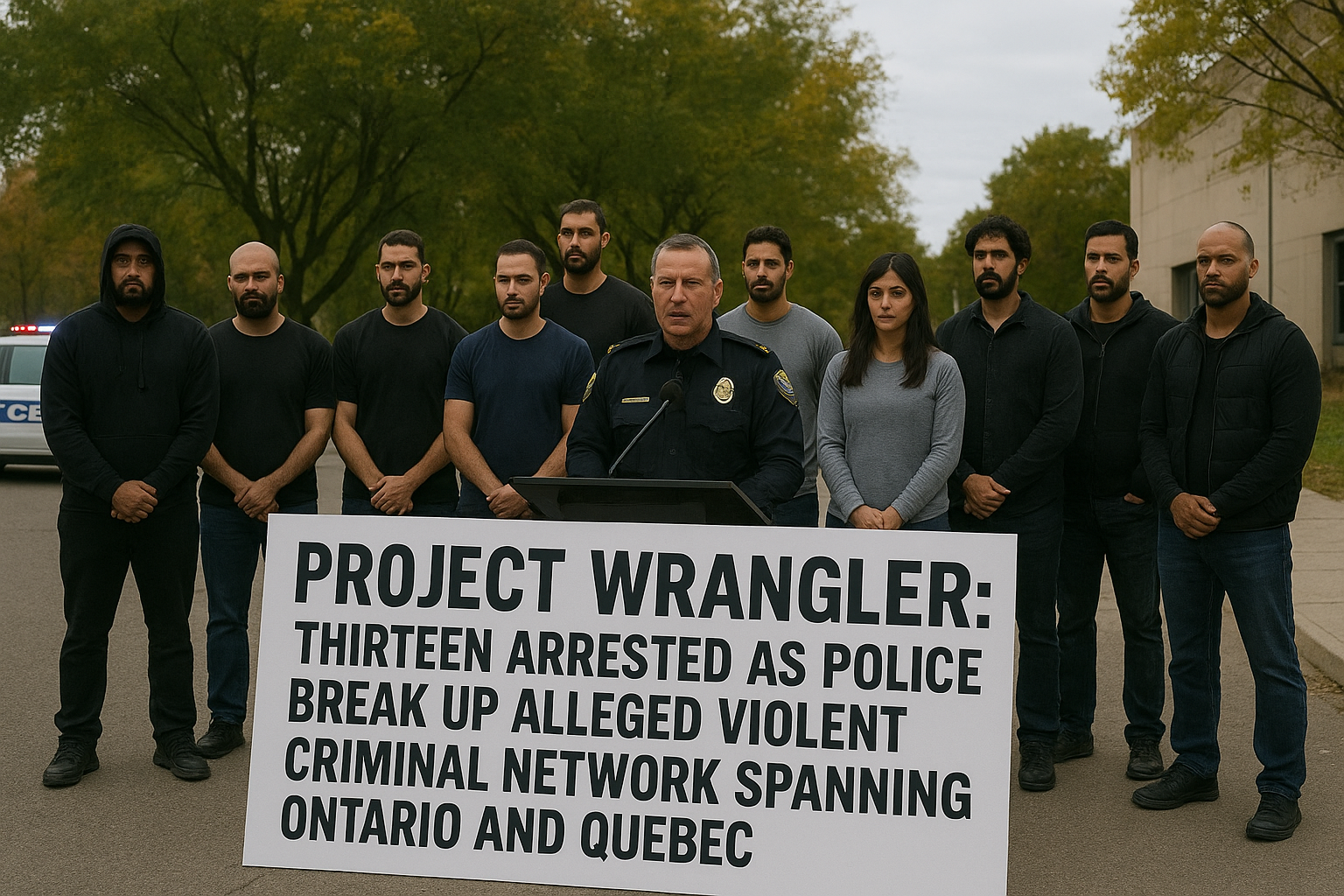

Project Wrangler: Thirteen Arrested as Police Break Up Alleged Violent Criminal Network Spanning Ontario and Quebec
A Coordinated Crackdown That Reshaped a Complex Investigation
What began as a routine analysis of several unrelated violent incidents quickly evolved into a sprawling, multi-jurisdictional investigation—one that ultimately brought together police agencies from across Ontario and Quebec. The resulting operation, known as Project Wrangler, has now led to the arrest of thirteen individuals, more than 150 criminal charges, and the identification of what investigators describe as an organized and exceptionally dangerous criminal group.
Police say the network’s activities were not only widespread but deeply alarming, involving offenses ranging from robbery and carjacking to attempted murder and first-degree murder. The scope of these allegations reveals a troubling pattern of escalating violence. And as one officer dryly noted during a briefing, “Criminal organizations don’t file customer service complaints—they escalate.” It was a grim joke, perhaps, but an apt observation about the stakes.
Against that backdrop, a Brampton resident is now charged with first-degree murder, two others from Peel Region face attempted murder charges, and authorities are still searching for two suspects who remain at large. The dismantling of this group, police say, marks a critical step in preventing further harm.
Unraveling the Network
Tracing Violence Across Two Provinces
Project Wrangler did not arise overnight. The investigation began after a string of violent incidents, reported between April 15, 2024, and March 20, 2025, raised red flags for police in southern and eastern Ontario as well as parts of Quebec. While early reports appeared isolated, investigators soon noticed similarities in execution, motive, and offender profiles.
As information accumulated, teams from multiple police services started sharing intelligence. A pattern emerged—one that pointed to a coordinated set of individuals moving through several cities while allegedly committing targeted attacks.
According to York Regional Police, these incidents included attempted murders, an attempted kidnapping, and numerous armed confrontations involving home invasions, carjackings, and robberies. Each event, taken alone, created serious concern. Together, they depicted a network operating with deliberate organization and escalating boldness.
Inside the Fictional Experience of an Investigator
For one detective—let’s call him Detective Harris—the moment when the puzzle pieces clicked into place happened during a quiet evening review of case files. “It was one of those moments,” he reportedly told a colleague, “where you stare at the board and realize the lines practically draw themselves.”
His fictional reflection mirrors a common reality in major investigations: the tipping point often arrives not with a dramatic break but with the calm recognition that scattered clues now form a cohesive thread. In Harris’s case, the thread led straight to individuals who were rapidly becoming a danger to multiple communities.
He joked later, quoting Tina Fey, that “being a detective sometimes feels like trying to put socks on a rooster.” But in this instance, the rooster finally stood still long enough.
A Calculated Enforcement Strategy
Bringing Multiple Police Forces Together
Once investigators confirmed the presence of an organized network, the operation expanded. York Regional Police took a leading role but worked alongside agencies in Peel Region, Hamilton, Toronto, Ottawa, and several jurisdictions in Quebec. The collaboration mirrored the suspects’ geographic footprint—fluid, mobile, and difficult to contain without a unified strategy.
Joint investigations often bring logistical complexity, but officers say the stakes demanded it. Violent criminal groups tend to exploit gaps between police jurisdictions, slipping from one region to the next with relative ease. Project Wrangler aimed to close those gaps. Officers relied heavily on intelligence sharing, coordinated surveillance, and synchronized enforcement actions.
Over time, what began as an inquiry into violent incidents evolved into a high-priority mission to disrupt an entire structure.
The Arrest Phase
As evidence solidified, police moved in. Thirteen suspects were taken into custody and charged with more than 150 offenses collectively. Charges range widely but include first-degree murder, attempted murder, kidnapping-related offenses, weapons charges, and robbery.
Among those arrested is a man from Brampton now charged with first-degree murder. Two additional suspects from Peel Region face attempted murder charges tied to separate incidents under the Project Wrangler umbrella. Their alleged roles, while still unfolding in court documents, reflect what investigators describe as a coordinated, hierarchical criminal operation.
Despite the sizable number of arrests, police say two suspects remain at large. One of them is a Hamilton man already wanted for first-degree murder. Officers continue to search for both individuals and are urging anyone with information to step forward.
Understanding the Allegations
A Group Characterized by Violence
Based on police statements, investigators believe the individuals arrested were working collectively as a criminal organization—one involved in violent confrontations with victims and rival parties alike. While the exact motive behind the group’s structure remains subject to courtroom scrutiny, police say the offenders operated with a notable level of intent and planning.
Violence, in many of the incidents, appears to have been used not just as a means to an end but as a tool of intimidation. Home invasions were reportedly aggressive, carjackings included armed threats, and attempted murders signaled a willingness to eliminate obstacles.
This pattern helps explain why several police services mobilized quickly to support York Region’s lead role. Criminal organizations employing this level of aggression represent a risk that extends far beyond individual municipalities.
A Broader Impact on Public Safety
Criminal groups of this nature often leave communities shaken long before arrests are made. Residents across several cities had been on edge, worried about the seemingly random nature of the incidents. Even those who did not experience violence directly felt the fear ripple through neighborhoods.
The ultimate arrest of thirteen suspects has brought some measure of relief. Yet police have emphasized that vigilance remains important, especially while two suspects are still wanted.
Community Reaction
Relief Mixed With Caution
Public reaction has been a blend of gratitude and wariness. Residents expressed appreciation for the coordinated policing effort, though many acknowledged lingering anxiety.
One local community member—fictionally, a shop owner named Rafi—recalled installing additional security cameras back in March. “When the news started coming out about all the incidents, I thought to myself: better safe than sorry,” he said. After the arrests were announced, he added, “It’s good news. But until they’re all caught, I’ll keep the cameras rolling.”
His cautious tone reflects a wider sentiment. Communities are reassured by the progress but recognize that investigations of this scale rarely conclude neatly.
What Comes Next
Legal Proceedings and Ongoing Searches
The accused individuals now face the court system, where the charges will advance through preliminary hearings and trial processes. Police have continued their search for the two outstanding suspects and are appealing for public assistance.
Investigators have made clear that Project Wrangler is ongoing in several respects. Additional evidence may still emerge. Further suspects could be identified. And the full scope of the criminal organization’s operations will likely gain clarity as proceedings continue.
A Reminder of the Importance of Cooperation
If Project Wrangler illustrated anything, it is the power of collaboration—both among police services and within local communities. Investigators repeatedly emphasized that public tips played a meaningful role in shaping the case. And the partnership between agencies across two provinces enabled a faster, more decisive disruption of the group.
As one officer summarized: “Crime travels. So must justice.”
Conclusion: A Significant Blow Against Organized Violence
The arrests under Project Wrangler represent a major step toward addressing a complex and dangerous criminal network that operated across significant sections of Ontario and Quebec. With charges ranging from murder to robbery to kidnapping attempts, the case underscores the seriousness of the threat posed by organized violent offenders.
Although two suspects remain at large, the operation has already curtailed the group’s capacity to inflict further harm. Communities, while still alert, can take some comfort in knowing that a concerted, coordinated effort is dismantling the network piece by piece.
The road ahead includes lengthy court processes and continued investigative work. Yet for residents and police alike, the progress achieved so far marks a meaningful stride toward restoring safety and security in the regions touched by these crimes.