
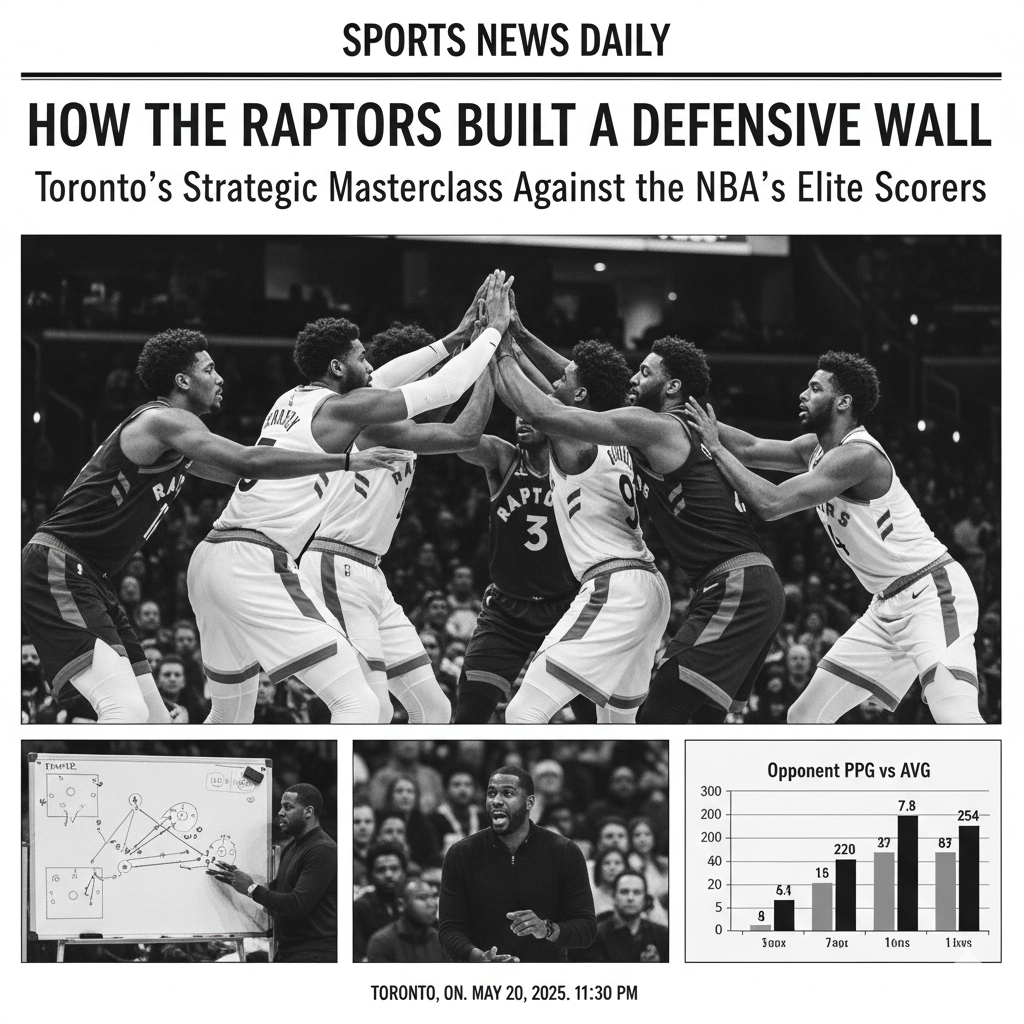

How the Raptors Built a Defensive Wall to Contain the NBA’s Elite Scorers
From Early Struggles to Defensive Dominance
The Toronto Raptors entered the NBA season with questions surrounding their defensive capabilities. In the first five games, the team went 1-4, ranking 29th in defensive rating, and opponents were carving paths to the basket with alarming ease.
Yet, in a dramatic turnaround, the Raptors have climbed to the second-best defensive rating in the league over their most recent nine games, trailing only the reigning champions from Oklahoma City. In a matter of weeks, Toronto has gone from one of the NBA’s most vulnerable defenses to one of its most formidable.
It’s not just numbers that reflect the change—it’s moments. During their eighth win in nine games, the Raptors’ reaction to Brandon Ingram’s authoritative fourth-quarter dunk over Charlotte seven-footer Ryan Kalkbrenner captured the team’s defensive and offensive intensity. Bench players leapt to their feet in unison, jaws dropped, and teammates on the floor, like Jamal Shead, were visibly in awe.
“Oh my goodness, that dunk was a little crazy,” Shead said after practice. “Everybody’s noticing he just looks lazy. He really isn’t lazy. He’s just tall. He got some big-ass shorts, you know? But he’s really not lazy.”
Appearances can be deceiving, but the Raptors’ defensive turnaround is real, measurable, and strategically driven.
The Role of Leadership and Commitment
Scottie Barnes Sets the Tone
Toronto’s resurgence began with a focus on defensive fundamentals and leadership from key players, particularly Scottie Barnes. Shead credits Barnes for elevating the team’s defensive standards.
“Scottie’s playing at a first-team all-defense level,” Shead said. “He’s kind of bringing us along with him, and I’ve been trying to be right there with him.”
Head coach Darko Rajakovic also highlighted Barnes’ influence, emphasizing how one player’s commitment can shift the culture of the team.
“After those first three losses, we realized we had to pick up on our defense,” Rajakovic explained.
Strategic Adjustments: Transition Defense
The Raptors’ defensive improvement isn’t a fluke—it’s the product of systematic adjustments, particularly in transition defense. Rajakovic noted that early in the season, the team often chased offensive rebounds without the likelihood of securing second-chance points, leaving them vulnerable to fast breaks.
“The idea is to get back and form the wall and prevent teams from scoring,” Rajakovic said. “That was our weakness to start the season. We were getting beat way too easily in the open court.”
Toronto’s approach now prioritizes sensible defensive positioning, balancing aggressive ball pressure with the need to contain open-court attacks. The shift has been supported by players willing to embrace high-effort defensive assignments, including Jamal Shead.
“I just told Jamal this morning, ‘What prevents you from being the best on-the-ball defender in the league? Nothing. You’ve got to own it, want it, and master your craft,’” Rajakovic said.
Defensive Effort Meets Offensive Efficiency
Interestingly, Toronto’s defensive focus hasn’t come at the expense of offense. As of Tuesday, the Raptors ranked eighth in offensive efficiency, demonstrating that a strong defense can complement and fuel scoring opportunities.
“Consistently good ball pressure—disrupting ballhandlers, shortening shot clocks, and creating chaos—is only possible with players receptive to coaching and willing to put in the effort,” Rajakovic said.
The Raptors’ young roster appears increasingly responsive and resilient, ready to execute both individual and team defensive strategies.
Preparing for Elite Scorers: The Tyrese Maxey Test
Toronto’s defensive evolution will face one of its toughest challenges against Tyrese Maxey of the Philadelphia 76ers. Maxey, averaging 32.5 points per game and leading the NBA in minutes played at 40 per game, represents an on-ball defensive test of the highest order.
“He plays with a lot of pace and energy, and he can sustain that over a long period,” Rajakovic said. “You need a team effort with multiple players rotating on him over the course of the game.”
Preparation for such matchups extends beyond physical effort. Rajakovic emphasizes the importance of film study, mastering player tendencies, and understanding league patterns.
“It’s hard work, but also rewarding work,” he said.
Signature Defensive Moments
Recent games have highlighted Toronto’s defensive growth in high-pressure situations. During Monday night’s win over Charlotte, the Raptors’ defining moments came on defense:
-
Brandon Ingram blocked Ryan Kalkbrenner’s dunk with just 10 seconds remaining.
-
Scottie Barnes made a buzzer-beating block against Collin Sexton, preventing a potential overtime basket.
These plays underscore the Raptors’ commitment to “winning plays”—defensive actions that directly influence the outcome of games. Rajakovic stresses that recognition in the NBA often favors scoring and highlight plays, but winning plays on defense are equally, if not more, impactful.
“That’s why Scottie Barnes is so important for our team. That’s why Jamal is so important. And we have several young players trending that way,” Rajakovic said.
Defensive Mindset and Culture
Toronto’s defensive success is rooted not only in strategy but also in mindset. Players are encouraged to embrace defensive responsibility, understand their roles, and commit to team-oriented effort.
For younger players like Shead, this represents an opportunity to develop into elite defenders, learning from veterans and through deliberate practice. The culture shift emphasizes that defense is as valuable as offense, and mastery of on-ball and team defensive skills can have a significant impact on the team’s trajectory.
Conclusion: A Raptors Team Built to Withstand the League’s Best
The Raptors’ rise from one of the NBA’s worst defenses to one of its strongest illustrates the power of leadership, strategy, and effort. By focusing on transition defense, on-ball pressure, and team cohesion, Toronto has built a defensive wall capable of challenging the league’s top scorers.
As they prepare to face elite talents like Tyrese Maxey, the Raptors demonstrate that defensive excellence is both teachable and contagious, with younger players stepping up to match the intensity of veterans.
“There are highlight plays, and there are winning plays,” Rajakovic said. “For us lately, the best are both.”
With this combination of talent, effort, and coaching, Toronto’s defensive resurgence may continue to define the team’s identity throughout the season.