Introduction: A Town United by Remembrance and Creativity
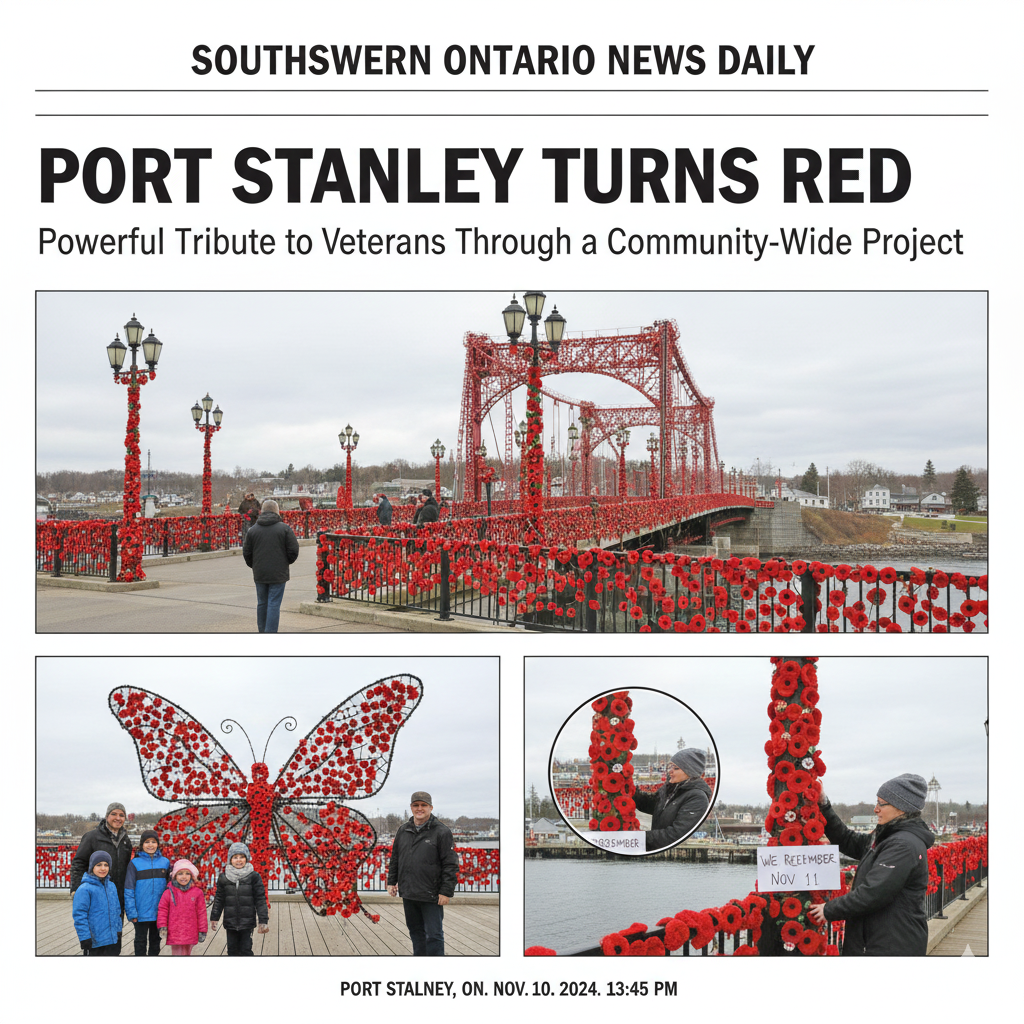
In the heart of Port Stanley, Ontario, a remarkable and deeply moving transformation is unfolding. Streets, storefronts, railings, signs, and public spaces have been adorned with thousands of handmade knitted and crocheted poppies, creating a sea of red across the lakeside town. This extraordinary effort, known as the Port Stanley Poppy Project, is more than a visually striking display — it is a heartfelt tribute to fallen soldiers and veterans, woven together by the hands of an inspired and dedicated community.
Led by local coordinator Kathy Howarth and supported by more than a hundred volunteers, the project has become a symbol of remembrance, unity, and artistic expression. Far from being just a decorative initiative, the Poppy Project reflects a shared commitment to honouring military service while strengthening the bonds between residents and drawing visitors from far and wide.
As Remembrance Day approaches, Port Stanley is not quietly reflecting — it is speaking loudly through colour, craft, and collective effort.
The Vision Behind the Poppy Project
Honouring Veterans Through Art
Kathy Howarth, the driving force behind the Port Stanley Poppy Project, found her inspiration in personal history and deep respect for those who served in wartime. With family roots in Belgium and vivid memories shared by her parents, who lived through the Second World War as children, the significance of honouring veterans runs deep for her.
Howarth envisioned something that went beyond a ceremonial moment or a single event. She wanted to create an experience that would touch both residents and visitors, immersing them in reflection and appreciation for the sacrifices made by soldiers. Her idea was simple but powerful: cover the town in poppies — the universally recognized symbol of remembrance.
“Port Stanley is such a vibrant, creative community,” she explained. “I wanted to add an extra layer to that, something that was meaningful and connected us all to history.”
What began as a personal thought in January quickly transformed into a full-scale town-wide undertaking.
From an Idea to a Community Mission
At first, Howarth doubted whether such an ambitious project could be achieved. But her next thought was decisive: if someone was going to make it happen, it might as well be her.
She began reaching out through local networks, community boards, and word-of-mouth, asking if anyone would be willing to knit or crochet poppies in their own time. The response was overwhelming. People of all ages and backgrounds volunteered — experienced crafters, complete beginners, students, retirees, business owners, and families.
What started as a handful of participants grew into a collective of 106 dedicated volunteers, all spending countless hours transforming yarn into a powerful symbol of remembrance.
The goal was not a few hundred poppies. It quickly became thousands.
Thousands of Handmade Poppies Across the Town
A Labour of Love
Each poppy is handcrafted, requiring focus, care, and nearly 30 minutes to complete. That means the more than 15,000 poppies now lining Port Stanley’s streets represent over 7,500 hours of volunteer work — time given freely in honour of others.
From lamp posts and park fences to storefront windows and railings, the town has been carefully decorated without losing its natural charm. The handmade flowers stand as both an artistic statement and a profound reminder of sacrifice.
Walking through Port Stanley now is a unique experience: every step is surrounded by symbols of remembrance. The town itself has become a living memorial.
Despite the sheer scale, the work was carried out in a quiet, respectful, and collaborative spirit. Volunteers met to exchange patterns, deliver bundles of poppies, and share stories about personal connections to the military. In many ways, the project became just as important for the living as it was for remembering the fallen.
A Small Town, A Big Impact
Port Stanley is home to just over 3,000 residents, making the creation and display of more than 15,000 poppies even more remarkable. The number of poppies far exceeds the population size, turning the project into a significant artistic and cultural accomplishment.
For a small town, organizing and executing something of this magnitude required commitment, coordination, and community pride. That pride is now visible everywhere, forming a striking contrast between the quiet lakeside setting and the bold red poppy displays.
Visitors who come to see the poppies don’t just encounter art — they experience the heart of a community determined to remember and respect.
Community Reaction and Emotional Impact
A Movement That Brought People Together
Jackie Valotaire, another coordinator involved in the project, says the response has been nothing short of extraordinary. From messages on social media to conversations with visitors who walk the streets in awe, the project has touched far more people than its organizers ever imagined.
“The reaction and response that we’ve seen within this community and beyond has been incredible,” she said. “It’s brought the whole community closer together.”
In a world where daily life often feels rushed and disconnected, the Poppy Project has offered a reason to slow down and reflect. It has sparked conversations about history, family, and sacrifice. Children have asked about the meaning of poppies. Elders have shared stories of relatives who served. Neighbours who had rarely spoken before now exchange smiles and stories while passing one another under strings of red flowers.
The project has strengthened relationships, created new friendships, and reminded residents of the power of unity.
Drawing Visitors While Preserving Meaning
Howarth also hoped the Poppy Project would encourage people to visit Port Stanley — and that goal has been achieved as well. The unique display has captured the attention of people from surrounding areas, bringing an increase in foot traffic and curious visitors eager to witness the red-covered town.
However, the project has not lost its respect or sincerity. At its core, it is not about tourism; it is about honour. Visitors are reminded to move through the town with reverence, understanding that the poppies are not simply decoration but a collective thank-you to those who have served and sacrificed.
In this way, the project balances beauty with meaning, art with respect.
The Symbolism of the Poppy Reimagined
For generations, the poppy has been a symbol of remembrance, inspired by the fields of Flanders that bloomed after the devastation of World War I. In Port Stanley, that symbol has been reimagined through handmade craftsmanship, bringing a deeply traditional emblem into a modern community setting.
Each poppy tells its own story — not just of fallen soldiers, but of the hands that made it, the memory that inspired it, and the love that shaped it. Unlike factory-made decorations, these flowers carry warmth, intention, and humanity.
They serve as a reminder that remembrance isn’t only expressed through ceremonies and speeches. It can be expressed through time, effort, and quiet devotion — one stitch at a time.
Conclusion: A Lasting Tribute That Will Be Remembered
The Port Stanley Poppy Project stands as a powerful example of what can happen when a community unites around a shared purpose. What began as one woman’s simple idea in January has blossomed into a breathtaking town-wide tribute, filled with colour, emotion, and respect.
Through more than 15,000 handcrafted poppies created by 106 committed volunteers, Port Stanley has transformed itself into a living memorial — one that honours the past while strengthening the present.
As people walk its streets, gaze at its buildings, and admire the sea of red, one message is clear: remembrance is not just about looking back. It is about carrying forward gratitude, unity, and the determination to never forget.